Ask any chief engineer, and they’ll tell you: a ship without ballast water is a ship that doesn’t sail safely. When cargo holds are empty or only partially loaded, vessels ride too high. They become unstable, hard to maneuver, and vulnerable in heavy seas. Ballast tanks fix that. Freshwater or seawater is pumped in to bring the hull down to a working draft low enough to steer properly, clear port infrastructure, and handle weather.
The trouble starts the moment that water is taken on. A ship pumping ballast in, say, Busan harbor isn’t just loading water. It’s loading whatever lives in that harbor: bacteria, plankton, crab larvae, algae, viruses, tiny molluscs, the lot. Everything that fits through the intake comes along for the ride. Some of it is microscopic. Some aren’t. All of it is alive.
When the ship reaches Rotterdam, or Houston, or Cape Town, and the ballast pumps run in reverse, those organisms get dropped into a completely different ocean. Most die. But some don’t, and the ones that survive in a new environment with no natural predators tend to do very well. Too well. That’s the invasive species problem, and ballast water has been spreading it across every major shipping lane on earth for over a century.
The Four-Stage Ballast Cycle
| Stage | What Actually Happens |
| Ballast taken on at the origin port | The ship has offloaded its cargo and rides high in the water. Pumps pull in local seawater or freshwater to bring the hull down to a safe operating draft. Everything living in that harbor water comes along with it. |
| Voyage underway | The water sits in sealed tanks for days, sometimes weeks, while the vessel crosses oceans. Organisms survive. Some reproduce. Sediment settles. By the time the ship arrives, the biological load may be higher than when it was loaded. |
| Ballast discharged at destination port | New cargo comes aboard, ballast goes out. The water, and everything in it, enters a marine environment it has never been part of. Without filtration, this is the point where invasive species get established. |
| Multi-port route complications | Ships don’t always sail point-to-point. On a route calling at five ports, ballast tanks may contain water from three different ocean regions simultaneously. Each discharge event introduces a different biological mix to a new location. |
The challenge of treat the ballast water
The ballast tanks can be compared to an aquarium, it has its own ecosystem. However, when it is discharged into another place in the sea, it is extremely harmful and dangerous to the local aquatic organisms.
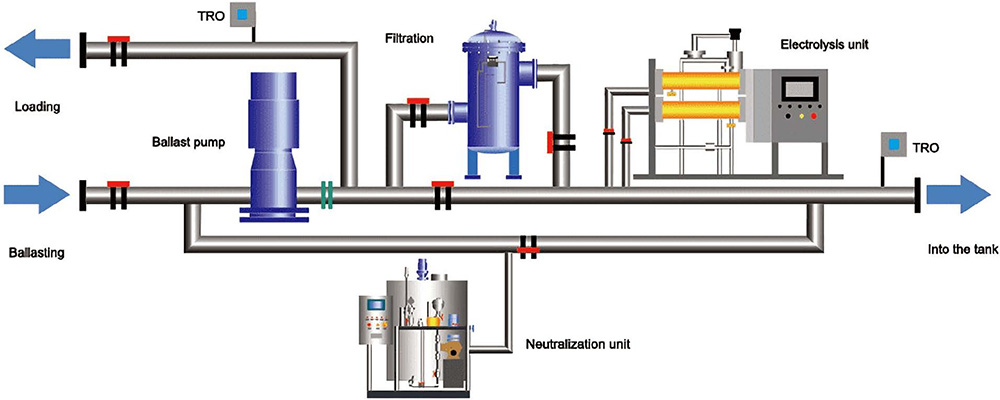
The objective of filtration is to prevent the emission of those organisms or other contaminants. There are large quantities of organisms in ballast water, such as jellyfish, crabs, bacteria, plankton, and viruses, which can easily block the downstream pipes and other equipment.
Why the Automatic Backwash Filter Became the Industry Standard?
When shipping companies started looking seriously at ballast water treatment after the BWM Convention passed, the core engineering problem was clear: you need something that filters massive volumes, runs continuously, doesn’t need manual cleaning, and can handle inconsistent water quality without falling over. The automatic backwash filter solved that problem, which is why it became the primary treatment stage on the majority of compliant vessels worldwide.
How the Backwash Cycle Works?
Water enters the filter housing and passes through a stainless-steel screen element rated at 50 microns. Organisms and particles too large to pass through collect on the screen. As the screen loads up, the pressure differential across it starts to rise. When it hits the set point, typically around 0.5 bar, the controller triggers a backwash: a flush valve opens, a small volume of already-filtered clean water runs backwards through the screen, and the collected material gets swept out through a discharge line back to sea. The whole cycle takes seconds. The main flow never stops.
Key Specifications
| Specification | Value / Detail |
| Filter Rating | 50 micrometers (μm) IMO BWM Convention D-2 standard |
| Cleaning Method | Automatic backwash self-cleaning, no manual intervention required |
| Operation Mode | Continuous 24/7 filtration continues during the backwash cycle |
| Backwash Discharge | Filtered organisms returned overboard near the source port |
| Compliance | IMO BWM Convention certified; suitable as the primary treatment stage |
| Secondary Stage | Typically paired with UV disinfection or electrochlorination |
Conclusion
Filtration is not only for the protection of the pipes and equipment but also for the aquatic environment. Sometimes, the profits can not be the only thing we care about; we should think about a long-term vision. The ballast water filtration is a good example of how we need to filter out the contaminants for the equipment and the local ecosystem.
Brother Filtration is deeply involved in the filtration field. We do everything about filtration, and we solve every filtration problem. More than manufacturing filter products, we also provide filtration solutions for our clients. Our automatic backwash filter could be your perfect choice for ballast water filtration.