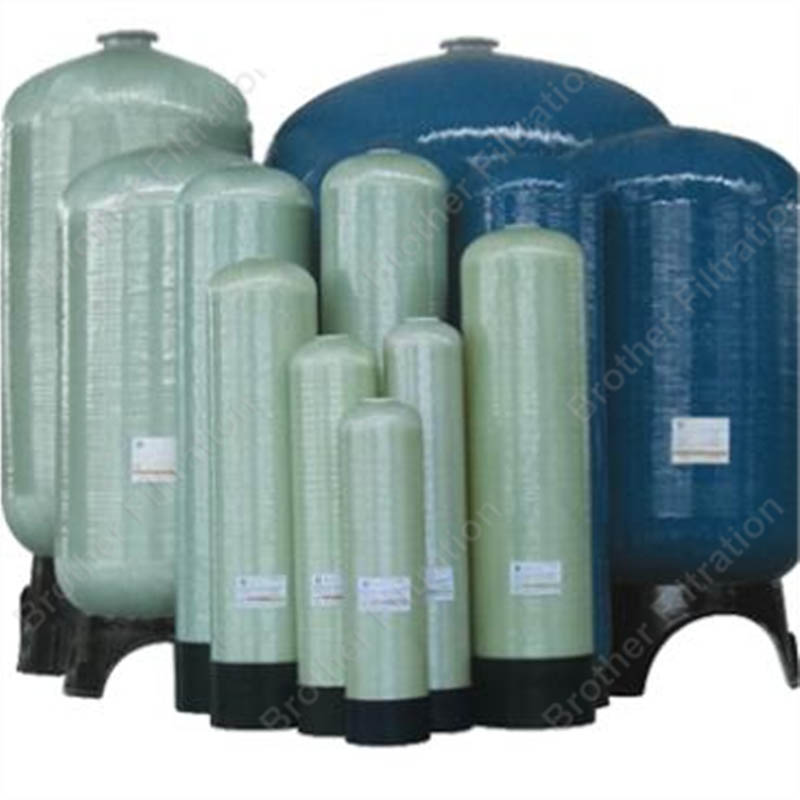
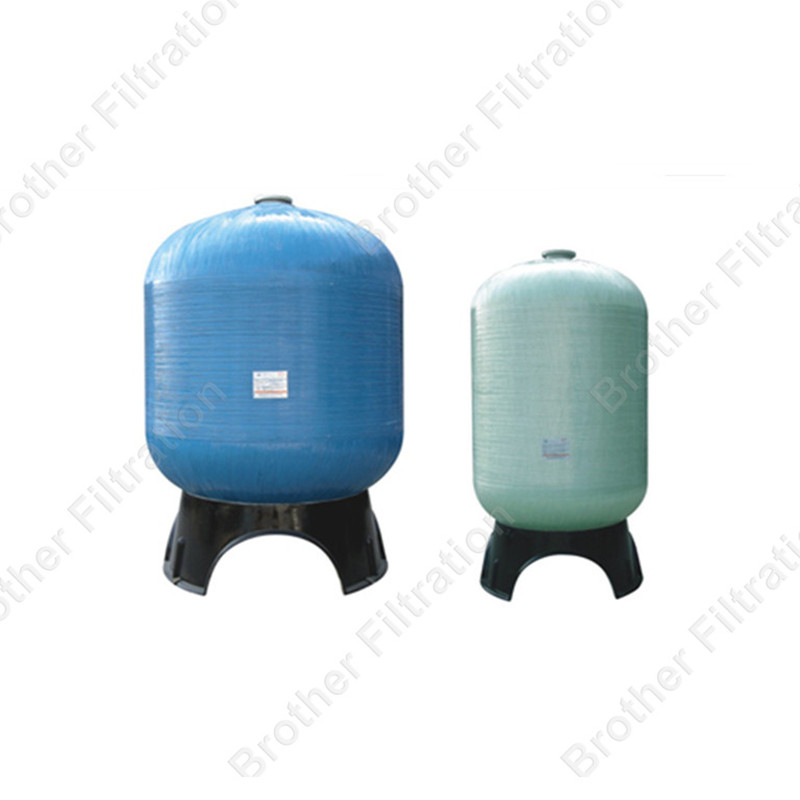
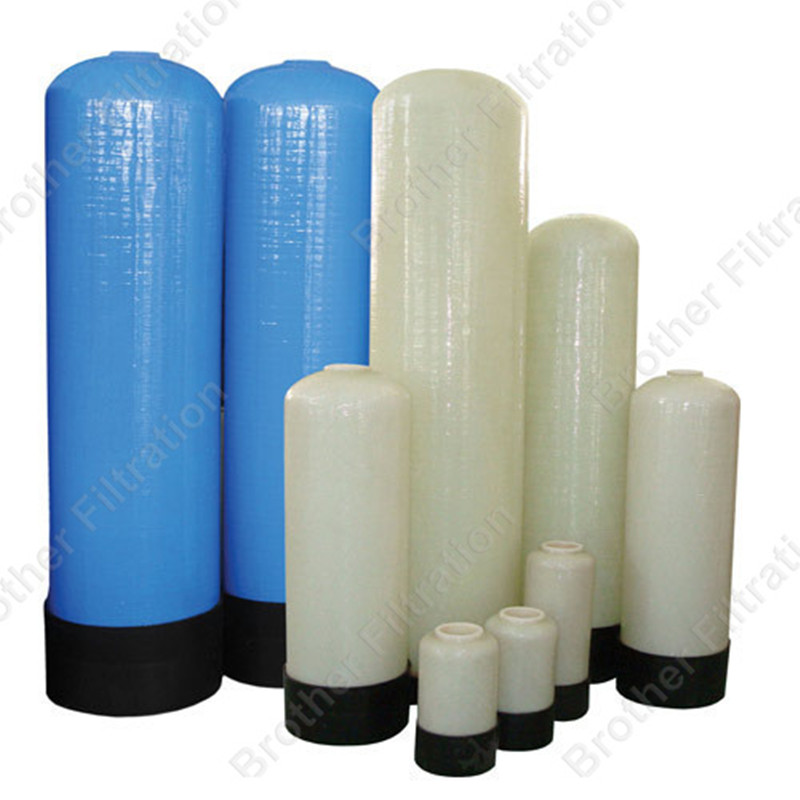
FRP Tanks(Fibreglass Reinforced Plastics) are composite vessels designed for applications where steel corrodes, and polyethene cannot handle the pressure. The fiberglass shell bonds to a polyethene liner during filament winding, producing a structure that holds up against aggressive chemicals, high-cycle pressure loading, and outdoor conditions that would degrade a metal tank within a few years.
Brother Filtration supplies FRP pressure tanks in more than 80 standard configurations, from 6-inch vessels used in residential softeners to 83-inch large-volume tanks used in municipal water treatment and industrial process systems. Every tank is built with a PE liner and FRP filament winding, manufactured and tested to NSF and CE-certified standards.
FRP pressure vessels are widely used across water treatment, wastewater, and municipal systems, chemical processing, food and beverage production, industrial manufacturing, and agricultural irrigation.
Why FRP Outperforms Steel and Polyethene?
The choice between FRP steel, and polyethene comes down to what the vessel holds, for how long, and under what pressure.
| Property |
FRP (Fiberglass) |
Carbon Steel |
Polyethene (PE) |
| Corrosion resistance |
Excellent, unaffected by most acids, alkalis, and salts |
Poor, requires lining or coating for chemical service |
Good, but limited pressure range |
| Operating pressure |
Up to 150 PSI standard |
High, but significantly heavier |
Low, typically 15–30 PSI max |
| Weight |
Light, roughly a quarter the weight of equivalent steel |
Heavy |
Light |
| Lifespan |
20–30 years in chemical service |
5–15 years without relining |
10–20 years with UV degradation risk outdoors |
| Maintenance |
Minimal, no painting, no relining required |
High, regular surface treatment needed |
Low |
| Food contact compliance |
NSF/ANSI 61, FDA-grade liner available |
Requires food-grade lining |
Available in food-grade grades |
| Contamination risk |
None, smooth PE liner, no rust or flaking |
Risk of rust particles in fluid |
None |
The practical advantage in filtration is straightforward. The PE liner eliminates the corrosion paths that cause steel tanks to develop pinhole leaks over time. In chemical service involving brine, chlorine, or acids, this is not a minor benefit; it is why FRP became the standard material for this class of application.