


CDU filters sit at different points along the cooling loop, and each one has a specific job: stopping particles before they reach heat exchangers, valves, pumps, and cold plates. Get the position or micron rating wrong, and you’re looking at fouling, pressure drop, or worse a cold plate that’s no longer doing its job properly.


Understanding CDU Filter Positions
Most CDU systems run more than one filtration point, and each one protects a different part of the loop. Coolant quality has a direct line to heat transfer efficiency and system stability, so getting the filter position and micron rating right isn’t a minor detail, it’s core to the design.
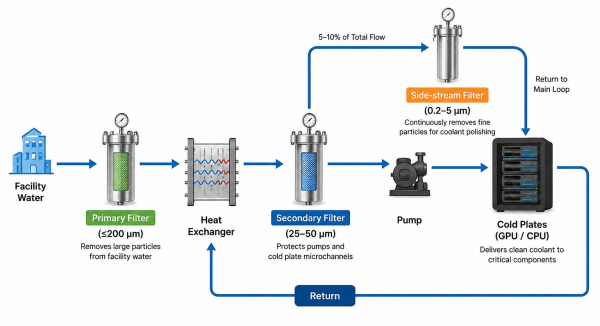
Primary Loop Filtration (FWS Side)
The primary loop is where the Facility Water System connects to the CDU heat exchanger. The job here is simple: keep the big stuff out before it ever reaches the CDU.
That usually means rust, pipe scale, and whatever debris got left behind during installation, the kind of contamination that’s common in building water systems. Skip filtering it out and it builds up inside the heat exchanger, dragging cooling performance down over time.
For this position, you’re typically looking at:
- ≤200 micron
- Stainless steel mesh construction
- Washable and reusable design
Secondary Loop Filtration (TCS Side)
The secondary loop, the Technology Cooling System loop is what actually carries coolant to the servers, GPUs, and cold plates. It’s a far more delicate part of the system, since coolant here runs through narrow microchannels built for high-efficiency heat transfer.
Even tiny particles cause problems in this loop: blockages, uneven flow, higher pressure drop, and all of that eats directly into thermal performance.
That’s why the secondary loop needs finer filtration. The standard here:
- 25 micron for in-rack CDUs
- 50 micron for in-row CDUs
Why 25–50 Micron Is the Industry Standard
Cold plate microchannels are built for efficiency, but that same design makes them touchy about contamination. Small particles don’t cause trouble immediately, they build up gradually, and eventually you get blockages, uneven flow, and rising pressure drop.
That’s the reason 25–50 micron has become the go-to range for CDU secondary loops. It strikes a workable balance, enough particle removal without choking off flow efficiency.
In dense AI server environments, this filtration range cuts down fouling and keeps pumps, valves, and thermal performance steady. It’s become common enough that many OEMs now list 25–50 µm as a baseline spec for direct-to-chip cooling.
What Material Should a CDU Filter Be Made Of?
Micron rating gets most of the attention, but it’s only half the story. What the filter’s wetted components are made of matters just as much as it determines coolant compatibility, corrosion resistance, and how long the thing actually lasts.
SS316L stainless steel is the standard choice for most CDU setups. It holds up well against deionized water, propylene glycol, and ethylene glycol the coolants you’ll typically find in these loops and its corrosion resistance is a real advantage when different metals are present in the same system.
That matters more than people expect in mixed-metal environments. Galvanic corrosion is a real risk when dissimilar metals sit in the same loop, and a properly built SS316L filter cuts that risk down, limits contamination from material breakdown, and keeps coolant cleaner over the long haul.
Is Hot-Swappable Filtration Necessary?
AI data centers don’t really stop running, so taking a CDU offline just to swap a filter isn’t a small ask, it’s an operational risk, and in high-density environments where thermal control can’t lapse, that risk gets bigger fast.
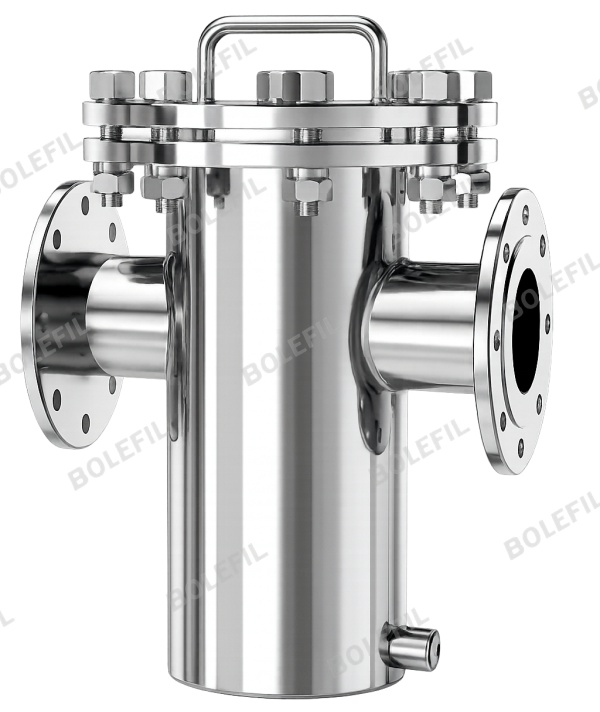
A hot-swappable filter housing solves this directly: operators pull and replace filters without interrupting coolant flow. Maintenance gets faster, downtime drops, and servers keep running the whole time.
For hyperscale and HPC facilities, where uptime is basically the whole game, hot-swappable filtration has gone from nice-to-have to something close to a default requirement.
What About Side-Stream Filtration?
Beyond primary and secondary filtration, a lot of CDU systems also run side-stream filtration for ongoing coolant polishing. Instead of filtering the whole flow, a side-stream filter pulls off a small slice, usually around 5–10% – and runs it through a much finer membrane.
These typically operate in the 0.2 to 5 micron range, often using PES membrane media built to catch the ultra-fine particles that standard mesh filters just pass through.
Run this continuously and coolant stays cleaner over time, less particle buildup, better long-term stability, particularly in closed-loop systems that run for extended cycles without a full flush.
Selecting the Right CDU Filter
The right filter comes down to two things: where it sits in the loop, and how much protection that position actually needs. Each stage does a different job, from catching coarse debris at the facility water inlet to stripping out fine particles before coolant reaches the server loop.
| Filter Position | Recommended Rating | Main Function |
| Primary (FWS) | ≤200 µm | Capture coarse debris from facility water |
| Secondary (TCS) | 25–50 µm | Protect cold plate microchannels |
| Side-stream | 0.2–5 µm | Continuous sub-micron purification |
CDU Filtration Solutions from BOLEFIL
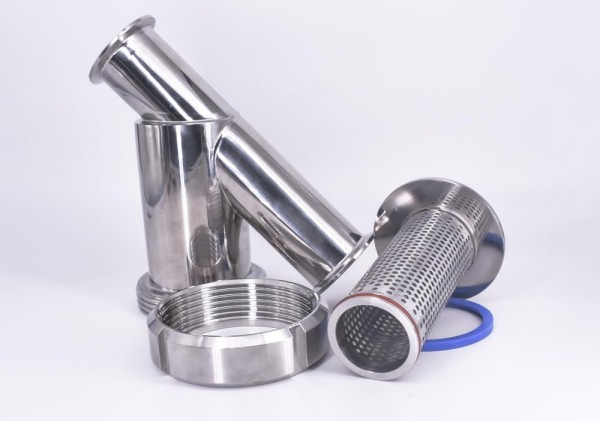
At BOLEFIL, we build complete CDU filtration solutions for liquid cooling systems covering everything from startup cleaning through long-term coolant polishing.
We also handle OEM customization on filter housings, connections, and materials, so the setup matches whatever CDU design you’re already running. Our filters work as drop-in replacements for existing CDU systems from major OEM brands too.
Get the filtration setup right, and coolant stays cleaner, components last longer, and cooling reliability holds up over time.
FAQs
What is the best micron rating for a CDU filter in AI data centers?
It depends on where the filter sits. Primary loop filters (FWS side) typically run ≤200 micron to catch coarse debris. Secondary loop filters (TCS side) need to be finer 25 micron for in-rack CDUs, 50 micron for in-row CDUs since that’s where coolant reaches the cold plates.
What’s the difference between 5 micron and 50 micron filters in CDUs?
A 5 micron filter catches far smaller particles and is typically used in side-stream polishing, not the main loop. A 50 micron filter sits in the secondary loop and is built to protect cold plate microchannels without restricting flow too much. Going too fine in the main loop can spike pressure drop; going too coarse in a side-stream filter defeats the point of polishing.
Do AI servers require smaller micron filters for liquid cooling?
Yes. AI servers run dense, high-heat workloads through narrow cold plate microchannels, and those channels are far more sensitive to particle buildup than standard server cooling. That’s why 25–50 micron has become the standard for secondary loop filtration in AI environments.
What does nominal vs. absolute micron rating mean for CDU filters?
A nominal rating means the filter captures most particles at that size roughly 85–95%, depending on the manufacturer. An absolute rating means it reliably captures particles at that size and above, with a much higher efficiency, usually 99%+. For sensitive cold plate loops, absolute-rated filters give more predictable protection.
Can particulate matter in coolant cause GPU thermal throttling?
Yes. Particles that build up in cold plate microchannels restrict flow and reduce contact with heat transfer surfaces. That drop in cooling efficiency can push GPU temperatures up, which triggers thermal throttling and cuts into performance.
Is stainless steel or polypropylene better for CDU filters?
For most CDU applications, SS316L stainless steel is the stronger choice, better corrosion resistance, better compatibility with mixed-metal loops, and longer service life. Polypropylene is lighter and cheaper but doesn’t hold up as well in loops with dissimilar metals or higher-temperature coolant.
What are the signs of a failing CDU filter?
Rising pressure drop across the filter, reduced flow rate, inconsistent cold plate temperatures, and more frequent thermal alarms are the usual signs. A sudden jump in pressure drop specifically points to a filter that’s clogged and due for replacement.
What is the ideal pressure drop for a CDU filter change?
There’s no single universal number; it depends on the filter and system design but most operators set a threshold based on the manufacturer’s spec, then flag replacement once pressure drop crosses that point rather than waiting for a fixed time interval.
Disposable vs. washable CDU filters for data centers which is better?
Washable stainless steel filters, common in primary loop filtration, cost more upfront but hold up over repeated cleaning cycles. Disposable filters are simpler to manage but add to ongoing costs and waste. Most facilities use washable filters upstream and disposable or membrane filters for finer, side-stream filtration.
How do you change a CDU filter while the system is running?
With a hot-swappable filter housing. It’s built with isolation valves that let operators pull and replace the filter cartridge without stopping coolant flow to the rest of the system which is why it’s become close to standard in facilities that can’t afford cooling downtime.
Conclusion
Picking the right CDU filter isn’t just about the micron number on the spec sheet. Position, material compatibility, and how easy the thing is to maintain all of it factors into whether your liquid cooling system stays stable or starts giving you problems six months in.
Primary loop protection, secondary loop filtration, side-stream polishing each one does something different. Get all three right and you end up with cleaner coolant, protected components, and cooling that holds up reliably in AI and HPC environments over the long run. Don’t let the wrong filter cost you uptime. Talk to BOLEFIL about a CDU filtration setup built for your loop, primary, secondary, and side-stream.
relevant products
Subscribe to our blog newsletter
Get the best, coolest and latest delivered to your inbox each week
[newsletter_form]