


Industrial filtration is a critical factor in maintaining the quality of the products, efficiency of the process, and compliance with the regulations of virtually any industry. Depth filter cartridges have become the gold standard of all available filtration solutions today, as they have proven to be the best solution in applications where high particle retention, low cost, and long-term serviceability are required.
This comprehensive guide will discuss the reasons why depth filter cartridges are essential in the modern industrial processes. We will look at their design benefits that are specific to them, make comparisons to other forms of filtration, the various uses of their products, and why Brother Filtration is a leading manufacturer in this field.
Understanding Depth Filtration Technology
Let us know how deep the filtration technology is
The Science Behind Depth Filter Cartridges
As opposed to surface filters, which trap particles only at the surface, depth filters are designed using a gradient density design, which entails a multi-layered structure that traps contaminants all over the thickness of the media. This advanced design has a number of different benefits:
Three-Dimensional Particle Capture
The filter matrix retains particles at varying depths, thus eliminating clogging prematurely as compared to the surface-only filtration.
This filtration process provides a much greater dirt-carrying capacity, and with this, the filter is able to hold as much as 10 times the contamination as surface filters.
The system ensures a longer time of efficiency and minimal replacements or cleanings by dispersing particles throughout the filter media, instead of at the surface, which consequently saves on time and resources.
Progressive Filtration Mechanism
The multi-layered filtration system is developed to ensure that its maximum efficiency is obtained, whereby the outer layers retain the larger particles, and the inside layers obtain smaller contaminants.
This progressive mode has the benefit of having each layer attack particular particle sizes, which eventually leads to a very pure effluent. The system has the ability to eliminate impurities at different levels with ease, resulting in high-quality output that can be applied in demanding applications.
Optimized Flow Dynamics
The system has lower pressure drops, and this is usually less by 20-30% compared to other options, which is an added advantage to the whole system. It also reduces the loss of pressure and hence the use of energy in pumping systems, which helps to save costs and enhance sustainability.
Also, the long periods of service between changeovers reduce the downtimes and maintenance needs, which further streamlines the operational performance.
Material Innovations in Modern Depth Filters
The new depth filter cartridges on the market today use state-of-the-art materials, which have better performance:
Polypropylene MeltBlown Media
Crystalline fibers with thermal bonding form a uniform pore-structure and are very dependable in terms of the filtration. The fibers are also difficult to dissolve in most chemicals and solvents and thus are applicable in hostile environments.
Also, they can be used in a variety of industrial and laboratory procedures, since they are effective in a diverse temperature range, between 0°C and 80°C.
Precision StringWound Construction
The product has several layers of yarn that are coiled at specific angles, thus making it suitable for working in viscous fluids and high particulate loads.
It comes in different materials that are used based on the requirements of the application, such as cotton, polypropylene, and glass fiber.
Activated Carbon Composite
This product is a combination of mechanical filtration and chemical adsorption that are effective in removing chlorine, odors and organic compounds in different applications. There are also special grades that can be used to cater to the high standards of the pharmaceutical applications, which are very pure and performing.
Industry-Specific Applications
1. Food & Beverage Processing
The depth filter cartridges are important in several aspects of food production:

Clarification of Edible Oils
- Removes phospholipids and oxidation products
- Retains clarity and shelf life of oil.
Beverage Production
- Last polishing of wines and spirits.
- Bacterial activity reduction of beer and juices.
- Bottling line prefiltration.
Dairy Applications
- Whey protein concentration
- Milk standardization
- Cheese brine filtration
2. Pharmaceutical Manufacturing
The rigorous pharma production demands reason why depth filtration is perfect in:
Biopharmaceutical Processing
- The harvesting of cell cultures.
- Elimination of cell debris during the making of vaccines.
- Sterilization of buffers and media.
Active Pharmaceutical Ingredients (APIs)
- Solvent filtration
- Catalyst recovery
- Final product polishing
3. Chemical Processing
The depth filters have a strong performance with the chemical manufacturers to gain:
Acid and Alkali Filtration
- Sulfuric acid clarification.
- Caustic soda purification
Solvent Recovery
- Coating filtration and paint.
- Recycled solvent cleaning
Catalyst Separation
- Precious metal recovery
- Process stream protection
4. Water Treatment Systems
Depth filtration is used in the municipal and industrial water systems:
Pretreatment for Reverse Osmosis
- SDI reduction
- Particulate removal
Wastewater Polishing
- Tertiary treatment
- Reuse applications
Cooling Tower Protection
- Scale prevention
- Biofouling control
The Brother Filtration Advantage
Brother Filtration is one of the foremost industrial filtration solutions manufacturers, and as such, has positioned itself by means of:
Engineering Excellence
Owned manufacturing processes.
Delicate quality control systems.
Continuous R&D investment
Product Range
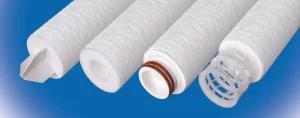
MeltBlown Cartridges
It has progressive density structure that will increase filtration performance and has gradual density structure to increase the efficiency of filtration that gives a 1100-micron rating against the effective retention of particles and the high flow rates to achieve the highest performance.
String Wound Cartridges
The product has absolute ratings of accurate filtrating, and chemically resistant products to act as surety in extreme conditions. It also has a large dirt capacity, which means that it has a long life and needs less maintenance.
Activated Carbon Cartridges
Activated carbon filters can be made from either coconut shell or coal-based materials, offering iodine values ranging from 800 to 1100, which indicates their adsorption capacity.
For applications requiring higher flow rates, pleated filter options are available to enhance performance and efficiency. These variations ensure suitability for different filtration needs while maintaining effective contaminant removal.
Custom Solutions
This is because each application is different, so we provide:
Material Customization
- Aggressive chemical special polymers.
- FDA-conforming food contact materials.
Size Variations
- Standard 10″, 20″, 30″, 40″ lengths
- Custom diameters available
Performance Enhancements
- Hydrophobic treatments
- Antimicrobial additives
- Conductive options
Maintenance and Optimization Tips
To maximize the performance and lifespan of your depth filter cartridges:
Best Practices in Installation
O-rings and seals should always be checked to make sure that they are in good condition, and they have to be used in the recommended directions to get the best performance. Also, dry starts of pleated filters should be avoided as they can be damaged.
Performance monitoring
Periodically monitor pressure differentials and changes in flow rate to identify possible problems as soon as possible. Visual checks may also be done to detect wear or contamination, prior to its impact on performance.
Replacement Indicators
Replace filters when ΔP (pressure differential) is greater than specified in the manufacturer’s instructions, the flow rate is slowed by more than 20%, or in case of observable changes in the quality of products. These guidelines help to achieve working efficiency and reliability.
Expert Editorial Comment
Depth filter cartridges are the top choice for industrial filtration due to their superior particle retention, cost-effectiveness, and reliability. Unlike surface filters, they trap contaminants throughout their multi-layered structure, offering higher dirt-holding capacity, lower pressure drops, and extended service life.
Advanced materials like polypropylene, meltblown, and activated carbon enhance their performance. They are indispensable across industries like Food & Beverage, Pharma, Chemical, and Water Treatment.
Brother Filtration stands out as a leading manufacturer, offering engineered, diverse, and customizable solutions for optimal filtration.
Frequently Asked Questions
How do depth filters capture particles differently from surface filters?
They trap contaminants throughout their entire thickness, not just on the exterior, preventing clogging and holding up to 10x more dirt.
What’s an efficiency gain with depth filter cartridges?
They offer lower pressure drops (20-30% less), saving energy and reducing downtime with longer service intervals.
What innovative materials are in modern depth filters?
Think polypropylene meltblown (chemical/temp resistant), precision string-wound (for viscous fluids), and activated carbon (for chemical adsorption).
Can I get custom depth filter solutions?
Absolutely! Manufacturers like Brother Filtration offer custom materials, sizes, and performance enhancements like hydrophobic treatments.
How do I make my depth filter cartridges last longer?
Proper installation (checking seals, flow direction), regular monitoring of pressure/flow, and replacing filters when ΔP or flow drops significantly are key.
relevant products
Subscribe to our blog newsletter
Get the best, coolest and latest delivered to your inbox each week