Inline Sanitary Filter Housings
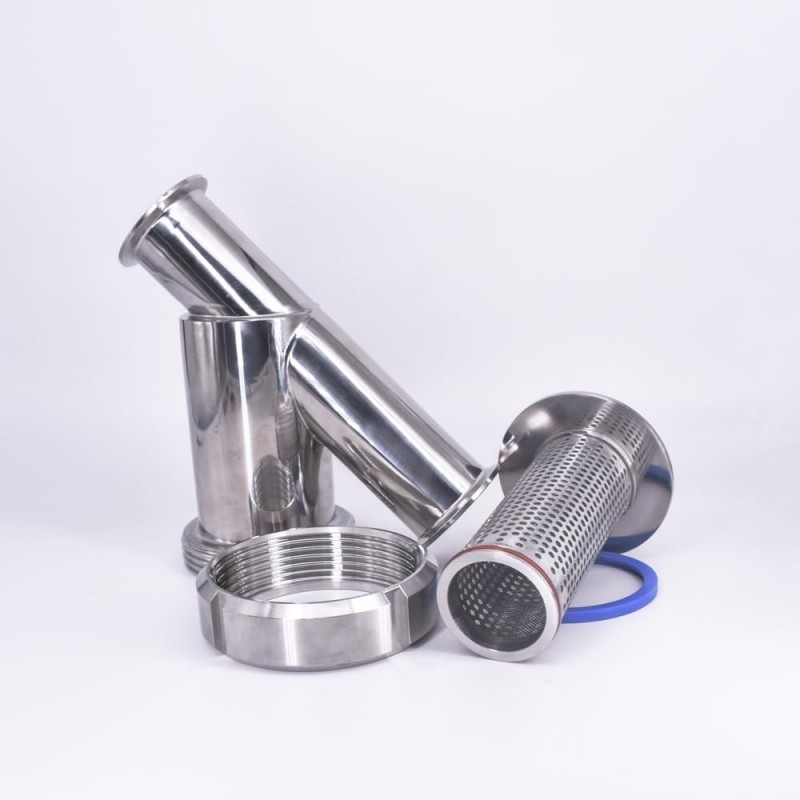
Polished stainless-steel sanitary housings with Tri-Clamp connections enable quick installation and easy cleaning. Their straight-through flow path maintains smooth coolant circulation with low pressure drop. This design suits high-purity environments and can integrate easily into data center cooling loops.
L-Strainers
L-strainers use a 90-degree configuration and robust housing, supporting higher flow rates and handling more viscous fluids. Many models allow in-line cleaning without stopping system operation. Customizable sizes, baskets, and drain ports make them suitable for various CDU frame layouts.
Y-Strainers
Y-strainers provide particulate filtration with flexible mounting angles, including 360-degree orientation. High-capacity versions handle larger flows or viscous liquids. Their adaptable design allows straightforward integration into systems where pipe routing is constrained.
FAQ
How does sediment affect liquid cooling cold plates?
Sediment that reaches a cold plate settles in its narrow internal channels, restricting coolant flow and reducing heat transfer at exactly the point where cooling matters most. Over time this raises component temperatures and can create localized hot spots even when overall system flow looks normal.
What happens if you don’t filter data center coolant?
Unfiltered coolant accumulates particles, corrosion byproducts, and biological growth that gradually clog pumps, cold plates, and heat exchangers. The result is rising pressure drop, reduced cooling capacity, and a higher risk of unplanned downtime as components wear faster than expected.
What micron filter is needed for liquid cooling?
Primary CDU filters typically target around 200 microns to capture larger debris before it reaches sensitive components. Secondary or side-stream filtration usually steps down to a finer 5-25 micron range, depending on how tight the tolerances are inside the cold plates and heat exchangers being protected.
Is side-stream filtration better than inline filtration for secondary loops?
Side-stream filtration is often preferred for secondary loops and immersion tanks because it continuously polishes a portion of the fluid without disrupting overall flow, extending fluid life. Inline filtration remains the standard for primary loops, where all flow needs to pass through the filter before reaching downstream equipment.
Bag filters vs. cartridge filters for data center cooling which is better?
Bag filters generally handle heavier particulate loads at a lower cost per change-out, making them a practical choice for primary-stage filtration. Cartridge filters deliver tighter, more consistent micron ratings, which makes them better suited to fine, secondary-stage filtration downstream of a bag filter.
What are the best self-cleaning filters for data centers?
The best self-cleaning filters for data centers use automatic backwash triggered by pressure drop, minimizing manual intervention in facilities that run continuously. Suction-scanner and outer-scraper designs are common choices, selected based on the particle size and flow rate of the specific cooling loop.
How do you prevent biological growth in data center cooling water?
Preventing biological growth combines regular water quality monitoring with appropriate biocide dosing where warranted, along with filtration that removes the organic material biofilm feeds on. Keeping the loop free of stagnant zones also reduces the conditions biofilm needs to establish.
Do you need DI water for data center liquid cooling?
Deionized water isn’t a strict requirement for every liquid cooling loop, but it reduces mineral scaling and generally improves fluid compatibility with sensitive components. Facilities running high-density AI or GPU racks often opt for DI water specifically to minimize long-term maintenance needs.
How do you prevent galvanic corrosion in cooling loops?
Galvanic corrosion is prevented mainly by avoiding direct contact between dissimilar metals in the loop, or by using dielectric isolation fittings where mixed metals are unavoidable. Maintaining proper water chemistry and filtration also limits the corrosion byproducts that can accelerate the problem once it starts.
How long does immersion cooling fluid last, and how do filters affect that?
Immersion cooling fluid can last several years with proper maintenance, but continuous side-stream filtration is one of the biggest factors extending that lifespan. Without filtration, particulate buildup and fluid degradation accelerate, often forcing earlier and more costly full-fluid replacement.
Conclusion
As data centers scale to meet the demands of AI and high-performance computing, clean liquid cooling keeps operations running smoothly. Proper CDU filtration protects hardware, stabilizes temperatures, and ensures reliable performance in high-density server racks.
Data center operators often turn to filtration solution providers like BOLEFIL. Our CDU filtration solutions help maintain efficiency, resilience, and future-ready performance.