...
Knowledge

In metal parts manufacturing, cleaning and degreasing are directly tied to product quality. Removing machining oil, grease, and fine particles isn’t just about surface appearance. It affects coating adhesion, assembly precision, and end-product performance.

Most industrial cleaning systems rely on solvents or water-based fluids to do this work. Early in operation, these fluids perform consistently. But over time, contamination accumulates: oil residues, metal fines, and degraded byproducts build up in the recirculating fluid.

When contamination isn’t managed, the consequences compound. Cleaning results become inconsistent, surfaces fail to meet specifications, and solvent replacement becomes more frequent. This drives up costs and reduces process stability. Filtration is what keeps this from happening.

Solvent Aqueous Cleaning

How Contamination Builds Up in a Recirculating Cleaning System

Parts enter the cleaning zone where solvent dissolves oils and dislodges particles from the surface. Larger contaminants may be skimmed off at this stage, but this only addresses the most visible portion of the contamination. Fine particles, emulsified oils, and dissolved residues remain in the fluid and continue circulating with every cycle.

Each pass through the system adds to the contamination load. The fluid becomes progressively dirtier, and its ability to clean effectively begins to decline. In a system without filtration, this process is invisible until the damage is already done. Cleaning performance drifts, surface quality becomes inconsistent, and parts begin to fail cleanliness inspections.

A properly designed filtration loop removes contaminants continuously, maintaining fluid quality and process stability without stopping the line. Rather than waiting for fluid quality to deteriorate, filtration keeps contamination under control from the start, extending solvent service life and delivering consistent cleaning results across every production shift.

Mixed Contamination Requires a Staged Approach

One of the most common mistakes in degreasing filtration is relying on a single filter stage to handle all contamination types. In practice, degreasing fluids carry a mix of:

Oil — coats filter media and progressively restricts flow

Fine metal particles — small enough to pass through coarse filters

Viscous residues — block pores quickly and shorten filter life

Each behaves differently during filtration. A single filter cannot manage all three effectively. The solution is a staged filtration system that targets each contamination type at the appropriate stage.

Filter Media Selection: Matching Material to Your Cleaning Fluid

Solvent compatibility is a non-negotiable factor in filter selection. Many degreasing systems use aggressive organic solvents such as hydrocarbons, ketones, or alcohols that can cause incompatible filter media to swell, lose structural integrity, or fail prematurely.

Two membrane materials are most widely used in industrial cleaning and degreasing applications:

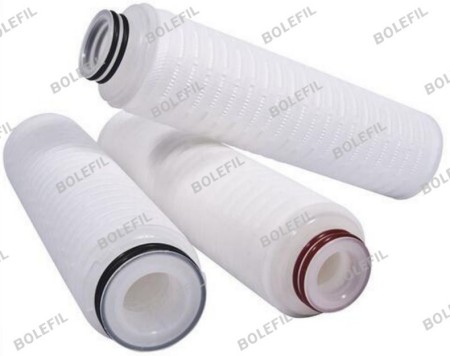
PTFE Membrane Filter Cartridges

PTFE (polytetrafluoroethylene) is the standard choice for solvent-based degreasing systems. It offers broad chemical resistance across organic solvents and maintains performance at elevated operating temperatures. PTFE membrane cartridges are typically used at the final polishing stage to achieve consistent fine particle removal before solvent recirculation.

PES Membrane Filter Cartridges

PES (polyethersulfone) is well suited to water-based cleaning systems and aqueous detergent processes. It provides stable flow performance and reliable fine particle retention in lower-chemical-intensity environments.

PTFE Membrane Filter Cartridges

How a Staged Filtration System Is Designed

A well-designed filtration system distributes the contamination load across multiple stages rather than concentrating it in one filter:

Stage 1 : Bulk particle removal Bag filters or depth cartridges capture larger particles and reduce the contamination load on downstream filters. This stage is critical for protecting membrane filters from premature loading.

Stage 2 : Intermediate filtration A secondary filter stage further reduces particle count and oil content before the fluid reaches the membrane stage.

Stage 3 : Membrane polishing PTFE or PES membrane cartridges remove fine particles and restore solvent clarity. This is the final quality checkpoint before the fluid re-enters the cleaning zone.

Filters can be positioned in recirculation loops, upstream of spray nozzles, or at dedicated polishing points depending on system layout.

This approach extends total filter service life, reduces maintenance frequency, and maintains cleaner, more stable fluid throughout the production run.

Selecting the Right Filtration Setup for Your Operation

Every cleaning system is different, and a filtration setup that works well in one facility may underperform in another. Specifying the right system from the start prevents costly mismatches and avoids the need for retrofits down the line.

Key variables to evaluate when specifying a filtration system include:

  • Cleaning fluid type (solvent-based vs. water-based)
  • Contamination profile (oil-dominant, particle-dominant, or mixed)
  • Target cleanliness specification
  • System flow rate and operating pressure
  • Temperature range
  • Process format (continuous recirculation vs. batch)

These parameters determine filter media selection, pore size, housing configuration, and the number of filtration stages required. For example, a high-flow continuous system processing heavily contaminated solvent will need a more robust staged setup compared to a low-volume batch operation with lighter contamination.

It is also worth considering future process changes. If your facility plans to switch cleaning fluids or increase throughput, building in flexibility at the filtration design stage is far more cost-effective than modifying the system later.

Conclusion

IIn any recirculating cleaning system, contamination buildup is a given. What isn’t a given is how well your filtration system manages it. A staged filtration approach, matched to your solvent chemistry and cleanliness targets, reduces solvent consumption, improves cleaning consistency, and extends the life of your entire cleaning system.

BOLEFIL supplies PTFE and PES membrane filter cartridges and stainless steel filters for industrial solvent filtration, water-based cleaning systems, and metal parts degreasing applications. Our products are used by OEM manufacturers, precision machining facilities, and industrial cleaning operations worldwide.

Our team is available to discuss your filtration setup and cleaning process requirements.

relevant products

Subscribe to our blog newsletter

Get the best, coolest and latest delivered to your inbox each week

Have Questions?