

Industrial water treatment recycling is how manufacturing plants cut freshwater costs, reduce wastewater discharge, and stay ahead of tightening environmental regulations, all at the same time. Most plants still run on a once-through model: fresh water in, process use, discharge out. That approach made sense decades ago. Today, with municipal water rates rising, discharge permit requirements getting stricter, and sustainability reporting becoming standard practice, it is leaving real money on the table.
This guide covers how industrial water treatment recycling works, which filtration systems manufacturing plants rely on, and why getting pre-filtration right is the foundation of every system that performs as designed.
What Is Industrial Water Treatment Recycling?
Industrial water treatment recycling is the process of treating used process water to a quality standard that allows it to be reused within the same facility or redirected to a lower-grade application, such as cooling or washing, rather than being discharged as wastewater. It connects two things most plants have traditionally managed as separate problems: wastewater treatment and water reuse. The result is a closed loop in which water remains productive within the system rather than flowing out as effluent.
This differs from basic industrial water treatment, which prepares incoming fresh water to meet process-quality requirements. Recycling goes a step further; it captures water that has already been used, cleans it back to a usable standard, and puts it to work again. That water can go back into high-purity applications like boiler feedwater, or into lower-grade uses like cooling tower make-up and wash cycles.
Industrial water reuse systems are now in use across manufacturing, power generation, food processing, chemical, pharmaceutical, textile, and metal finishing plants. Any facility that uses water as part of its process can recover and reuse a meaningful share of it.
Why Manufacturing Plants Are Prioritizing Water Recycling
Several things have changed in recent years, making industrial water recycling a business decision rather than just an environmental one.
Freshwater costs are climbing
Industrial water rates have increased in drought-stressed regions, and treated reclaimed water typically costs 20 to 50 percent less than a fresh municipal supply over a full system lifecycle. For a mid-size plant pulling several million gallons annually, that gap is material.
Discharge limits are tightening
Environmental permit programs place strict limits on what manufacturing plants can discharge into waterways. Facilities that recycle more water internally generate less effluent, which directly lowers permit compliance risk and discharge surcharges. Every gallon recycled is one less gallon to treat and account for.
ESG reporting is becoming non-negotiable
Investors and large corporate customers now require verified water footprint data. A closed-loop industrial water reuse system provides sustainability teams with metrics they can report, such as gallons recycled, freshwater withdrawn per unit of production, and wastewater discharged year over year.
Water scarcity is an operational risk
Plants that have built water recycling into their operations are less exposed to supply disruptions, drought restrictions, and the price spikes that follow. A well-selected industrial filtration system is often the first practical step toward building that resilience.
According to the US Geological Survey, thermoelectric power and self-supplied industrial use together represent two of the largest categories of freshwater withdrawals in the United States
How Industrial Water Treatment Recycling Systems Work?
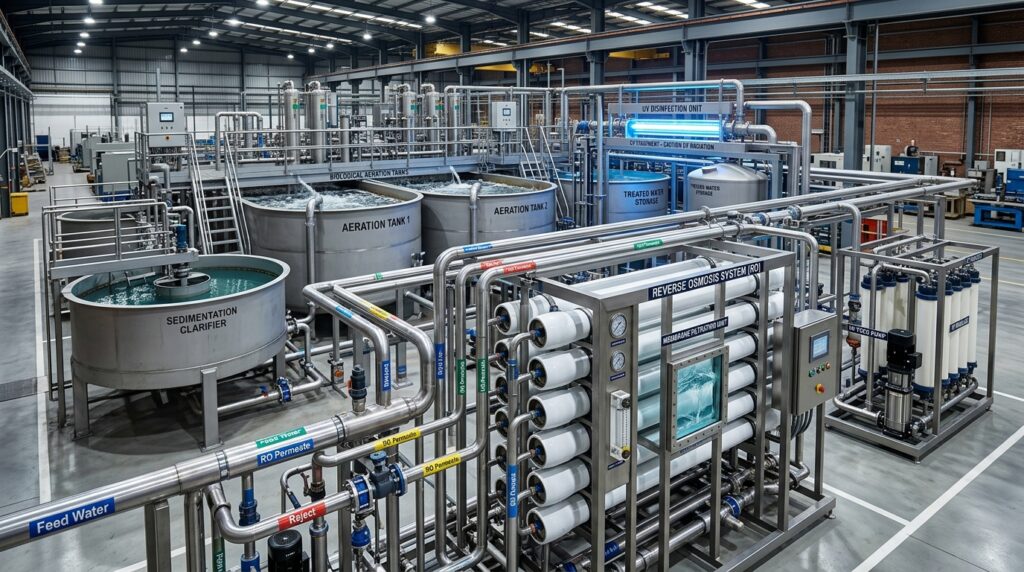
Modern manufacturing water recycling systems move water through several treatment stages, each targeting a different category of contamination. Here is how a complete system works from inlet to reuse:
Step 1: Pre-Treatment and Solids Removal
The first stage removes suspended solids, oils, coarse debris, and particles that would quickly foul or damage downstream membranes. This is handled through screening, sedimentation, and pre-filtration using cartridge filters or bag filter housings. For plants with heavy solids loads in metal finishing, food processing, and pulp and paper, a clarifier or dissolved air flotation (DAF) unit may also be needed at this stage.
For those working through the strainers vs filters question in industrial water treatment: strainers handle the coarsest debris at the system inlet, while cartridge and bag filters take over at finer micron ratings before water reaches membranes. Both have a role, and neither should be skipped.
Pre-filtration is the single most important factor in membrane system longevity. An RO or UF membrane fed pre-filtered water inadequately will foul faster, require more frequent chemical cleaning cycles, and fail well ahead of its rated service life, turning a missed filtration step into a membrane replacement cost. In practice, the investment in proper pre-filtration pays back many times over in extended membrane life and reduced system downtime.
Step 2: Primary and Biological Treatment
With coarse solids removed, the water enters a stage targeting dissolved organic material, the contamination that drives up BOD and COD readings, causes odor, and fouls membranes. Activated sludge systems, aeration tanks, and membrane bioreactors (MBRs) use microorganisms to break this down. MBR systems are increasingly common in new industrial wastewater recycling designs because they combine biological treatment and membrane filtration into a single compact unit with consistently higher-quality output.
Step 3: Membrane Filtration (UF / NF / RO)
This is where water reaches the quality level needed for reuse. Three membrane technologies cover the range:
Ultrafiltration (UF) removes fine particles, bacteria, and remaining suspended solids at low operating pressure. It is suitable for cooling tower make-up, wash water circuits, and as pre-treatment ahead of RO.
Nanofiltration (NF) removes hardness ions, multivalent salts, and organic compounds without the full energy cost of RO. It is the right choice when partial softening is the goal.
Reverse osmosis (RO) removes dissolved salts, heavy metals, and total dissolved solids (TDS) under high pressure, producing permeate of near-deionized quality. RO output is suitable for boiler feedwater, high-purity process water reuse, and cooling tower make-up. The concentrate stream either goes to a ZLD system or is managed separately.
Step 4: Polishing and Disinfection
Before recycled water re-enters the process, activated carbon filtration removes residual organics and chlorine. UV disinfection or biocide chemical dosing then handles microbial safety. Industrial water treatment chemicals, antiscalants for RO membranes, biocides for cooling circuits, and pH adjustment chemicals support the system at this stage. They work best when the underlying water quality has already been controlled by upstream treatment stages.
Step 5: Reuse or Zero Liquid Discharge (ZLD)
Treated water routes back to cooling towers, boiler systems, wash stations, or process water circuits. For facilities that need to eliminate liquid discharge due to permit requirements or are located in a water-scarce area, the RO concentrate is evaporated and crystallized until only dry solids remain. ZLD systems achieve water recovery rates of 95 percent or higher, with the solids leaving the system as manageable solid waste.
Key Industrial Water Recycling Applications in Manufacturing
Recycled water works across more applications than most plant managers initially expect. Here is how different industries actually use it:
Food and Beverage: Recycling focuses on non-product-contact uses, CIP pre-rinse cycles, equipment washing, cooling circuits, and boiler feedwater. Food-grade industrial wastewater filtration is critical for preventing contamination at product-contact points.
Chemical Processing: Chemical plants produce wastewater with complex profiles, solvents, heavy metals, and high TDS. Membrane filtration and multi-stage treatment recover water for reuse in cooling systems and utilities. Careful management of industrial water treatment chemicals is needed to protect membranes from process chemistry.
Pharmaceutical Manufacturing: Pharma facilities require ultra-pure water and face strict discharge standards due to trace amounts of active pharmaceutical ingredients (APIs) in effluent. Recycling systems here typically use RO followed by electrodeionization (EDI) to meet USP Purified Water standards, with recycled water directed to utilities and non-production washing.
Textile Manufacturing: Textile dyeing plants use large volumes of water and discharge wastewater that is heavily colored and has high TDS levels, two characteristics that make treatment particularly difficult. A single treatment stage cannot handle it, so most systems work through the contamination in steps: coagulation first, then biological treatment, membrane filtration, and activated carbon polishing. For large facilities, ZLD is increasingly a regulatory requirement rather than an option, especially in regions where colored discharge into waterways has drawn regulatory attention.
Metal Finishing: Plating, anodizing, and phosphating operations use large volumes of rinse water contaminated with heavy metals and process chemicals. Industrial wastewater filtration systems recover rinse water while the concentrate is processed for metal recovery or hazardous waste disposal, directly reducing both freshwater use and disposal costs.
Power Generation: Power plants recycle cooling tower blowdown through UF and RO, returning it as make-up water, one of the highest-volume industrial water reuse applications in operation. Even modest improvements in recovery translate to millions of gallons saved annually.
Industrial Water Treatment Methods: Traditional vs. Recycling-Optimized Systems
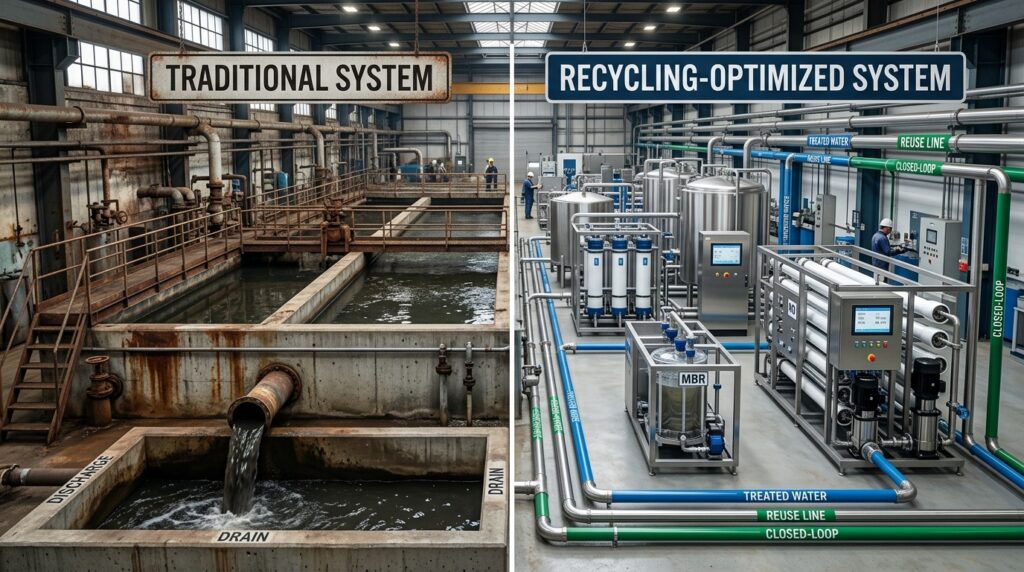
Most older manufacturing plants were designed around a once-through model. Freshwater came in, was used, and left as wastewater. That worked when water was cheap and discharge limits were loose. Both conditions have changed.
| Factor | Traditional Once-Through | Recycling-Optimized System |
| Freshwater consumption | High- full demand met by fresh intake | 30–70% lower – recycled water replaces a large share |
| Wastewater generation | High- most intake becomes discharge | Significantly reduced – internal reuse cuts discharge volume |
| Operating costs | Rising- water prices and discharge fees are trending up | Lower long-term OPEX – both water and discharge costs reduced |
| Equipment wear | Variable- dependent on incoming water quality | Reduced – controlled water chemistry lowers scaling and fouling |
| Regulatory exposure | Higher- more discharge volume, more permit risk | Lower – less discharge reduces compliance burden |
| Sustainability metrics | Weak – high freshwater footprint | Strong – lower footprint, documented reuse performance |
| Long-term resilience | Vulnerable to price rises and scarcity | More resilient – less dependent on external supply |
Most facilities phase the transition in: starting with the highest-volume or easiest-to-treat streams, cooling tower blowdown, wash water, boiler condensate return, and expanding as the economics justify each additional stage.
Benefits of Industrial Water Recycling for Manufacturing Plants
The case for industrial water treatment recycling comes down to four measurable benefits.
Reduced Freshwater Costs
Recycled non-potable water for cooling, washing, and boiler feed can replace 30 to 60 percent of a plant’s municipal or groundwater intake. In high-water-cost regions, the payback period on a well-specified manufacturing water recycling system is typically three to five years. Where water access costs include infrastructure charges or groundwater depletion fees, payback is often shorter.
Lower Wastewater Discharge Costs
Every gallon recycled is one less gallon to treat and discharge. Lower effluent volume means lower discharge treatment costs, lower sewer surcharges, and less permit compliance exposure. Plants operating near their permitted discharge limits gain operational headroom and avoid the cost and disruption of permit review when production volumes or chemistry change.
Extended Equipment Life
Scaling, corrosion, and fouling in boilers, cooling towers, and heat exchangers are driven by poor water quality, hard water, high TDS, unstable pH, and biological growth. Industrial hard water treatment, built into a recycling loop, continuously controls calcium, magnesium, and total dissolved solids. That protects capital equipment more effectively than intermittent chemical dosing, which reacts to problems that have already formed rather than preventing them.
Regulatory Compliance and ESG Reporting
A recycled water system generates continuous, documented quality data, inlet quality, treatment performance, and reuse volumes. That simplifies permit reporting, supports renewals, and gives sustainability teams verified figures for ESG disclosures and corporate water stewardship reporting. The wastewater treatment process provides additional context on how treatment and compliance documentation work together.
Choosing the Right Filtration Components for Your Water Recycling System
The headline technologies RO, ZLD, and MBR receive the most attention when recycling systems are being specified. But long-term system performance is determined upstream, by the pre-filtration components that protect them. A well-designed filtration train is not just maintenance; it is what keeps the entire recycling system running stably and cost-effectively over its full operating life.
Cartridge filters and bag filters handle suspended solids at the pre-treatment stage and serve as the first line of defense for downstream membrane or process equipment. Cartridge filters suit lower-flow, fine-filtration applications where tight micron ratings are required; bag filters handle higher-flow, higher-solids loads where large volumes of contamination must be captured cost-effectively before they reach sensitive components. Both must be matched to actual process water conditions, micron rating, filter media, and housing material, all of which need to account for pH, operating temperature, and chemical compatibility. A mismatch here shortens filter life and increases replacement frequency.
UF membranes serve as both a standalone recycling technology for applications that do not require full RO purity and a critical pre-treatment step before RO systems. A properly specified UF stage intercepts fine particles, bacteria, and biological material that cartridge pre-filtration alone cannot fully capture, preventing them from reaching the high-pressure RO membrane, where fouling damage is far more costly to address.
RO systems deliver the highest water purity in a recycling loop and are used where boiler feedwater or high-purity process reuse is the target. RO membrane performance depends almost entirely on the quality of the water entering the system. That is why the pre-filtration specification for cartridge filters, bag filters, and UF membranes protecting the RO matters as much as the RO system itself. Compromising on pre-filtration to reduce upfront cost is the most common and most expensive mistake in industrial water recycling system design.
Self-cleaning and automatic backwash filters are the right choice for high-flow cooling water and wash water recycling circuits that require continuous operation. Rather than stopping the flow for a manual cartridge change-out, self-cleaning filters automatically purge captured solids and return to full filtration without interrupting the process, maintaining consistent filtration performance over extended operating periods and reducing both labor and unplanned downtime.
Getting filtration right at every stage, pre-treatment, membrane protection, and continuous-flow applications, is what separates water recycling systems that hit their design performance targets from those that fall short within the first few operating years.
The US Department of Energy’s Better Plants program publishes water-efficiency case studies and benchmarking data for manufacturing facilities, which are useful in building an internal business case for water-recycling investments.
Common Questions About Industrial Water Treatment Recycling
What’s the Difference Between Microfiltration and Reverse Osmosis?
Microfiltration removes bacteria, sediment, and suspended solids using membranes with pore sizes of 0.1–10 microns. Reverse osmosis operates at 0.0001 microns, about 1,000 times finer, stripping dissolved salts, heavy metals, PFAS, and virtually all remaining contaminants. In industrial systems, microfiltration typically serves as pre-treatment to protect the downstream RO membrane.
How Often Should I Replace My Industrial Cartridge Filters?
Replacement frequency depends on contamination load and flow rate, standard sediment cartridges in moderate applications last 1 to 3 months, while pre-RO cartridges in cleaner water can last 3 to 6 months. The most reliable trigger is differential pressure: when the pressure drop across the housing hits the manufacturer’s limit (typically 15–20 psi), replace it regardless of how long it has been in service.
What Happens If I Don’t Change My Filters Regularly?
An overloaded cartridge stops capturing contaminants effectively, forces the pump to work harder, and, in systems protecting RO or UF membranes, allows particles to reach and foul the membrane directly. Membrane fouling and pump damage cost far more to fix than a missed filter change.
What Are the Standard Sizes of Industrial Bag Filters?
Bag filters follow a standard sizing system used by most housing manufacturers, making it straightforward to source replacements. The four sizes are #1 (7″×17″), #2 (7″×32″), #3 (4″×9″), and #4 (4″×15″). For industrial water treatment, Size #2 is specified most often, as it handles the high flow volumes most facilities deal with. Micron ratings range from 1 to 200, and the right rating depends on what you are trying to remove and what equipment sits downstream.
How Do Bag Filters Work in Industrial Water Treatment?
The principle is simple. Water flows into the housing, pushes through the filter bag from the inside out, and exits clean through the outlet. The bag sits inside a perforated basket that keeps it supported under pressure; without that basket, the bag would collapse and burst. Particles and suspended solids stay trapped inside the bag as water passes through the wall. Once the pressure difference between the inlet and outlet reaches the change-out threshold, it is time to swap the bag. That is why bag filters make sense for high-flow, high-solids duty; they hold far more contamination before needing to be changed than a cartridge of comparable size would.
Start With the Right System Design
Industrial water treatment recycling reduces freshwater costs, cuts wastewater discharge expenses, protects equipment, and makes compliance more manageable, all from a single investment. It works across sectors from pharmaceuticals to metal finishing, and the economics improve every year as water costs and regulatory requirements increase. Getting the pre-filtration specification right from the start is what separates systems that perform as designed from those that fall short within the first few years.
If you are evaluating filtration components for a new or upgraded industrial water recycling system, speak with Brother Filtration to identify the right pre-filtration specification for your application, flow requirements, and process water chemistry.
relevant products
Subscribe to our blog newsletter
Get the best, coolest and latest delivered to your inbox each week