


Choosing the right industrial filter cartridge is one of the most important decisions in any water treatment or liquid processing setup. Whether you are running a pharmaceutical plant, a food and beverage facility, a reverse osmosis system, or a municipal water treatment station, the type of filter cartridge you use directly affects the quality of your output, the lifespan of your equipment, and the overall efficiency of your operations.
This FAQ covers the most common questions engineers, procurement managers, and plant operators ask when selecting industrial filter cartridges, from pharmaceutical-grade filtration and micron ratings to RO pre-treatment and melt blown filter mechanics. If you are looking for reliable solutions, Brother Filtration offers a comprehensive range of cartridges and housings built for demanding industrial applications across the globe.
What Type of Filter Cartridge Should I Use for Pharmaceutical Water?
Pharmaceutical water filtration is one of the most demanding applications in any industry, where the wrong filter choice can lead to product contamination, batch rejection, or non-compliance with FDA, WHO, USP, and EP standards.
For pharmaceutical water, the two most recommended options are membrane pleated filter cartridges and sterilizing grade filter cartridges. Membrane pleated filters made from PES (polyethersulfone), PVDF, or Nylon membranes deliver high flow rates with precise particle retention, making them ideal for final filtration of APIs, buffers, and Water for Injection (WFI) systems. PES is the go-to choice for aqueous solutions due to its hydrophilic nature and broad chemical compatibility. PVDF handles aggressive solvents and strong oxidizers. Nylon works well for general laboratory and water purification steps.
When selecting a pharmaceutical-grade filter cartridge, look for these qualities: an absolute micron rating for validated particle removal, low extractables and leachables, compatibility with hot water sanitization or steam sterilization, full traceability with batch certificates, and an integrity-testable design via bubble point or diffusion testing.
For WFI loops, purified water systems, and CIP circuits, pair stainless steel housings with high-integrity membrane cartridges. Brother Filtration membrane pleated cartridges are integrity tested during production, fully traceable, and manufactured from pure raw materials free from binders and additives.
Learn more in our complete guide to Pharmaceutical Water Filtration Systems.
What Is the Difference Between Nominal and Absolute Filter Ratings?
One of the most misunderstood concepts in industrial filtration is the difference between nominal and absolute filter ratings. Both describe the size of particles a filter can remove, but they do so in very different ways, and choosing without understanding the distinction can lead to filtration failures or unnecessary over-engineering.
| Feature | Nominal Rating | Absolute Rating |
| Definition | Removes a percentage of particles at the stated micron size | Removes 99.98% or more of particles at the stated micron size |
| Efficiency | Typically 85 to 98 percent, varies by manufacturer | Validated via Multi-Pass Test (ISO 16889) |
| Standardization | Not standardized, varies by brand | Standardized, backed by Beta Ratio testing |
| Beta Ratio | Not applicable | Beta 5000 or higher at the rated micron size |
| Typical Filter Type | Melt blown depth filters, string wound filters | Pleated membrane filters, sterilizing grade filters |
| Best Used For | Pre-filtration, sediment removal, coarse debris control | Final filtration, pharma, semiconductor, food and beverage |
| Cost | Lower | Higher |
| Particle Breakthrough Risk | Some particles may pass through | Virtually none at the rated size |
A good multi-stage system combines both. A nominal depth filter in the pre-filtration stage removes the bulk particle load and extends the life of the downstream absolute membrane filter, reducing operating costs without compromising final output quality.
Read our detailed comparison of Nominal vs. Absolute Filter Ratings.
What Micron Filter Removes Bacteria from Water?
Bacteria removal is one of the most common objectives in both industrial and municipal water filtration. If your process requires water that is free from bacterial contamination, selecting the correct micron rating is essential. Using an undersized filter wastes money, while using one that is too coarse lets bacteria pass straight through.
Most bacteria range in size from 0.2 microns to about 10 microns, depending on the species. Common waterborne bacteria such as E. coli, Pseudomonas, and Legionella fall in the range of 0.5 to 5 microns. To reliably remove bacteria from water, you need a filter with an absolute rating of 0.2 microns. This is the standard pore size used in sterilizing grade filters, which are designed specifically to produce sterile filtrate by physically blocking all bacterial cells.
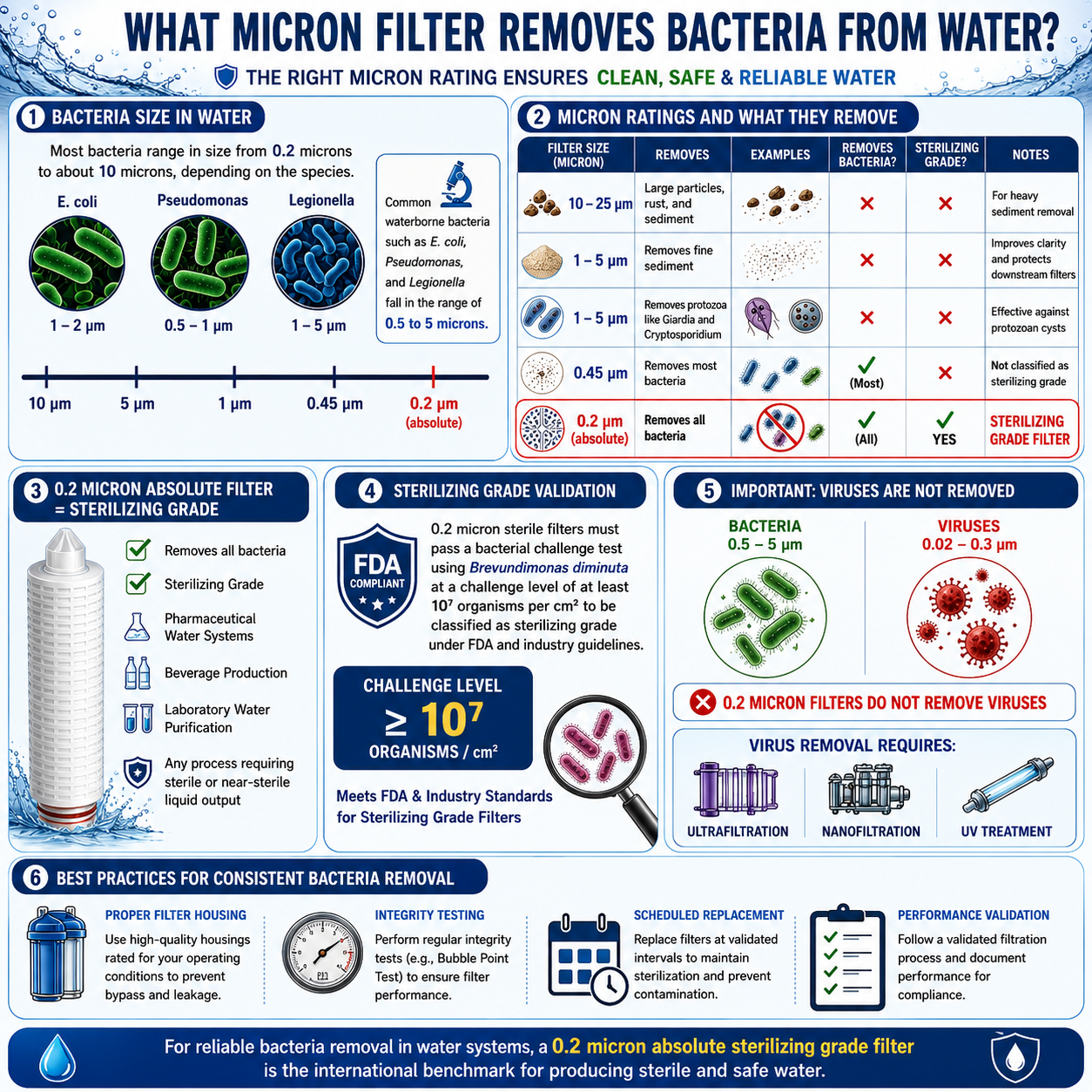 Micron ratings and what they remove:
- 10 to 25 micron: Removes large particles, rust, and sediment
- 1 to 5 micron: Removes fine sediment, protozoa like Giardia and Cryptosporidium
- 0.45 micron: Removes most bacteria but is not classified as sterilizing grade
- 0.2 micron (absolute): Removes all bacteria and qualifies as a sterilizing grade filter
A 0.2 micron absolute membrane filter is the international benchmark for sterilizing filtration. It is widely used in pharmaceutical water systems, beverage production, laboratory water purification, and anywhere the process demands a sterile or near-sterile liquid output. These filters must pass a bacterial challenge test using Brevundimonas diminuta at a challenge level of at least 10^7 organisms per square centimeter to be classified as sterilizing grade under FDA and industry guidelines.
It is important to note that 0.2 micron filters do not remove viruses. Viruses are typically 0.02 to 0.3 microns in size, and removing them requires ultrafiltration membranes, nanofiltration, or UV treatment. For most industrial applications involving bacteria removal, a 0.2 micron sterilizing grade cartridge filter is sufficient and remains the most practical and cost-effective solution.
If you are using cartridge filters for bacteria removal, always pair them with proper housing, regular integrity testing, and a validated filter replacement schedule to maintain consistent performance over time.
Explore our guide to Sterilizing Grade Filter Cartridges.
How Do I Select the Right Industrial Filter Manufacturers in the USA?
Selecting the right industrial filter manufacturer in the USA is just as important as choosing the filter itself. A wrong supplier can result in inconsistent product quality, compliance failures, supply delays, or premature system breakdowns. Making the right choice requires evaluating several technical and operational factors before committing to a manufacturer.
The key factors to evaluate when selecting an industrial filter manufacturer in the USA:
- Certifications and compliance: Confirm the manufacturer holds ISO 9001 certification, uses FDA-compliant materials, and meets NSF/ANSI standards relevant to your industry
- Industry expertise: Verify they have proven experience in your specific application, whether pharmaceutical water, RO pre-treatment, food and beverage, or chemical processing
- Product range: A reliable manufacturer should supply the full spectrum including melt blown, pleated membrane, string wound, activated carbon cartridges, and compatible housings
- Integrity testing and documentation: Ensure the manufacturer provides batch-level certificates, integrity test data, and full traceability for every production run
- Custom manufacturing capability: Confirm they support custom micron ratings, lengths, end cap configurations, and OEM formats for non-standard system requirements
- Lead times and local support: US-based manufacturers reduce logistics complexity, shorten delivery timelines, and provide accessible technical support when issues arise
Brother Filtration manufactures a full range of industrial filter cartridges and housings built to meet demanding applications across pharmaceutical, food and beverage, chemical, and water treatment industries. Their products are integrity tested during production, fully traceable, and backed by dedicated technical support for clients across the USA and globally.
For pharmaceutical and regulated industries, always choose a manufacturer that provides complete compliance documentation including extractables and leachables data, challenge test results, and sterilization compatibility reports. These documents are essential for regulatory submissions and validated process qualification.
For general industrial use, prioritize manufacturers that offer broad chemical compatibility across their product range, flexible sizing options, and reliable stock availability to minimize downtime during unplanned maintenance or emergency changeouts. Always match the manufacturer’s stated material certifications to the chemical and temperature requirements of your specific process fluid.
See our Industrial Filter Housing Selection Guide.
What Is a Sterilizing Grade Filter Cartridge?
A sterilizing grade filter cartridge is a filter that has been validated to produce a sterile filtrate by completely removing all microorganisms from the process liquid. It is the highest performance classification for liquid filtration and is specifically designed for applications where the presence of bacteria in the final product is not acceptable under any circumstances.
By definition, a sterilizing grade filter must achieve a Log Reduction Value (LRV) of at least 7 when challenged with Brevundimonas diminuta at a concentration of 10^7 colony forming units per square centimeter of filter area. This standard is established by the FDA Guidance for Industry on Sterile Drug Products and by the PDA Technical Report No. 26. In simple terms, the filter must be capable of retaining all viable bacteria even under worst-case challenge conditions.
Sterilizing grade filters are always rated at 0.2 microns (for aqueous applications) or 0.1 microns (for oily or viscous fluids where bacteria may behave differently). They are typically constructed from PES, PVDF, or Nylon membrane materials and are pleated into a cylindrical form to maximize surface area within a compact housing.
Common applications for sterilizing grade filter cartridges:
- Final filtration of injectable drugs and biological products
- Sterilization of culture media and buffer solutions in biotech manufacturing
- Filtration of ophthalmic solutions and topical formulations
- Sterile venting applications in fermenters and bioreactors
- Filtration of gases and compressed air in cleanroom environments
Every sterilizing grade cartridge must undergo integrity testing before and after use. The most common test methods are the bubble point test and the forward flow (diffusion) test. These tests confirm that the filter membrane is free from defects and has not been compromised during handling or installation. A failed integrity test means the batch filtration cannot be released until the cause is identified and resolved.
Brother Filtration produces sterilizing grade membrane cartridges that are 100 percent integrity tested during manufacturing, fully traceable with batch documentation, and compatible with steam sterilization and autoclave cycles, making them ready for direct use in validated pharmaceutical processes.
Learn how Sterilizing Grade Filters are used in pharmaceutical manufacturing.
How Often Should Industrial Filter Cartridges Be Replaced?
Filter cartridge replacement frequency is one of the most common operational questions in industrial filtration. Replace too early and you waste money. Replace too late and you risk filter failure, pressure loss, contamination, or damage to downstream equipment. The right answer depends on several variables that are specific to your system and your process fluid.
The most reliable method for determining when to replace a filter cartridge is pressure differential monitoring, also called delta P monitoring. Every filter has a rated initial pressure drop and a maximum terminal pressure drop beyond which the cartridge should be changed. When the differential pressure across the housing reaches the manufacturer’s stated limit, typically 30 to 50 PSI for most industrial cartridges, it is time to replace the element regardless of how long it has been in service.
General replacement guidelines by application type:
- Municipal and industrial water treatment: Replace every 3 to 6 months depending on turbidity and sediment load
- Food and beverage production: Replace based on volume throughput or when pressure drop limit is reached, whichever comes first
- Pharmaceutical manufacturing: Replace after each batch, or on a validated schedule based on process volume
- RO pre-treatment: Replace sediment pre-filters every 6 to 12 months, or sooner if pressure drop rises significantly
- High-flow industrial systems: Monitor differential pressure weekly and replace when terminal pressure is reached
Time-based replacement schedules are common in applications where measuring differential pressure is not practical, such as small point-of-use systems. In these cases, a conservative time-based approach is used as a safeguard. However, for any serious industrial application, pressure monitoring will always give you a more accurate and cost-effective replacement signal.
Never run a filter beyond its terminal pressure drop. Doing so can cause the cartridge to collapse structurally, releasing trapped contaminants back into the clean side of the system and potentially causing significant downstream contamination or equipment damage. High-flow filter cartridges from Brother Filtration are engineered with robust support structures that resist collapse even under challenging pressure conditions, but they are not immune to extreme misuse.
Keep a maintenance log for every filter housing in your system. Record the installation date, the initial differential pressure, and regular readings thereafter. This data helps you build a replacement history and predict future service intervals based on your actual operating conditions rather than general estimates.
Read our filter maintenance and replacement guide.
What Is the Best Filter for RO Pre-Treatment?
Reverse osmosis systems are a major investment, and protecting the RO membranes from fouling, scaling, and physical damage is critical to getting a long and productive service life out of them. Pre-treatment filtration is the first line of defense, and selecting the right cartridge filter for this stage can make the difference between an RO system that runs efficiently for years and one that requires constant maintenance and early membrane replacement.
The primary purpose of an RO pre-treatment filter is to remove sediment, suspended solids, chlorine, and organic matter before the water reaches the RO membrane. Most RO membranes are intolerant of free chlorine and particulate matter above 5 microns. Exceeding these limits causes membrane oxidation, scaling, and biofouling, which reduces water output and raises operating pressure over time.
A well-designed RO pre-treatment filter train typically includes:
- A coarse sediment filter (25 to 50 micron, nominal) to remove large particles and protect the finer pre-filters downstream
- A fine sediment filter (1 to 5 micron, nominal or absolute) to remove fine suspended solids and reduce the SDI (Silt Density Index) to below 5, which is the standard requirement for most RO membranes
- An activated carbon filter or cartridge (if chlorine is present) to remove free chlorine and chloramines before the water reaches the RO membrane
Melt blown polypropylene depth cartridges are the most widely used choice for RO pre-treatment sediment filtration. They offer a graded density structure that captures large particles on the outer layers and finer particles toward the core, which extends service life and reduces the frequency of cartridge changes.
String wound cartridges are another popular option for RO pre-treatment, particularly in applications with heavy sediment loads. They offer a similar depth filtration mechanism and are available in a wide range of micron ratings and materials to suit different feed water conditions.
For high-capacity RO systems treating large volumes of water, high-flow filter cartridges in multi-element housings are an efficient solution. They reduce the number of housings required and simplify the overall pre-treatment system footprint, which is especially valuable in plants where space is limited. Brother Filtration offers more than 50 types of high-flow cartridges compatible with all major housing brands, making it straightforward to upgrade or expand an existing RO pre-treatment system.
Discover the best RO pre-treatment filtration solutions.
How Does a Melt Blown Filter Work?
A melt blown filter cartridge is one of the most common types of depth filter used in industrial water treatment, RO pre-treatment, and general process filtration. Understanding how it works helps you select and use it correctly.
Melt blown cartridges are made by extruding thermoplastic material, usually polypropylene, through a series of tiny nozzles using high-velocity hot air. The air stretches and cools the molten polymer into fine fibers that are randomly deposited onto a rotating mandrel. The result is a cylindrical filter with a gradient density structure: finer fibers in the center and coarser fibers on the outer surface.
This graduated density is what makes a melt blown filter effective. Larger particles are captured at the outer layers, while progressively smaller particles are trapped deeper in the filter wall as the liquid moves toward the center. This depth-loading mechanism allows the cartridge to hold a much larger particle load before pressure drop becomes unacceptable, compared to a surface filter of the same size.
Because melt blown cartridges are made entirely of polypropylene with no adhesives, binders, or surfactants, they are chemically pure and suitable for a wide range of liquids including acidic and alkaline solutions. They are also FDA-compliant for food contact applications.
Brother Filtration manufactures melt blown cartridges in micron ratings from 1 to 100 microns, available in 10 inch, 20 inch, 30 inch, and 40 inch standard lengths, as well as big blue and high-flow formats. Custom sizes and micron ratings are available for OEM customers. For applications requiring tighter performance specifications or higher dirt-holding capacity, Brother Filtration also offers string wound and gradient density pleated alternatives.
Read our complete Melt Blown Filter Cartridge Guide.
About Brother Filtration
Brother Filtration is a manufacturer and global supplier of industrial filter cartridges, filter housings, and complete liquid filtration systems. With a dedicated R&D team and decades of filtration experience, Brother Filtration serves clients across pharmaceutical, food and beverage, water treatment, chemical, and industrial sectors. Their product range covers high-flow cartridges, membrane pleated cartridges, melt blown depth filters, string wound filters, and a full line of single and multi-cartridge stainless steel housings. Custom designs and OEM services are available for clients with specific application requirements.
relevant products
Subscribe to our blog newsletter
Get the best, coolest and latest delivered to your inbox each week