Why Bag Filter Housings Still Have a Place
Bag filtration has a different role in a liquid cooling filtration strategy.
During commissioning and flushing, a newly installed cooling loop may contain construction debris, rust, scale and other particles that are not representative of normal operating conditions.
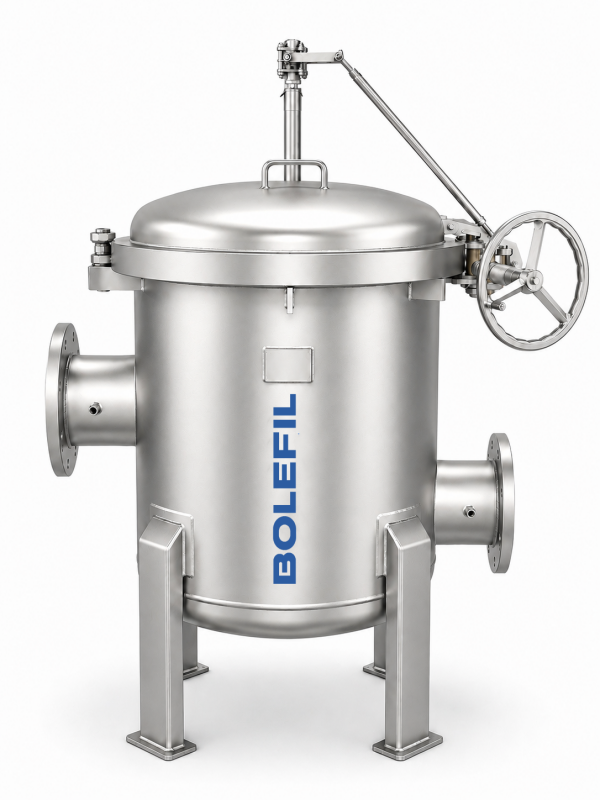
A bag filter housing provides a straightforward way to handle this type of higher particulate load.
Its practical advantages include:
- Simple operation
- Flexible filter bag selection
- Easy media replacement
- High dirt-loading capability
- Practical use for commissioning and prefiltration
Using bag filtration during flushing can help prevent the normal operating filtration system from being exposed to an unusually high contamination load.
Bag filter housings can also be considered as an upstream prefiltration stage where reducing the particulate burden before downstream cartridge filtration is beneficial.
Commissioning filtration and normal operating filtration do not necessarily need to use the same technology.
Don’t Select a Liquid Cooling Filter by Micron Rating Alone
One of the first questions in a filtration project is often:
“What micron rating do we need?”
Micron rating is important, but it is only one part of the selection process.
A liquid cooling filter should be evaluated according to the complete operating condition, including:
Flow rate : What are the normal and maximum design flow rates?
Pressure drop : What pressure drop can the system tolerate when the filter is clean and as it becomes loaded?
Contamination profile : What particles are expected, and where are they coming from?
Coolant chemistry : Are the filter media, housing and seals compatible with the actual cooling fluid?
Maintenance strategy : How frequently can the filtration system be inspected, cleaned or replaced?
Filtration location : Is the filter being used on the facility side, within a CDU, on a secondary loop or for side-stream filtration?
These factors determine whether a high-flow cartridge, automatic self-cleaning filter, bag filter housing or a combination of technologies is appropriate.
Build the Filtration Strategy Around the Cooling System
Different filtration technologies can serve different functions within the same cooling infrastructure.
High Flow Filter Cartridges
For high-volume continuous filtration where flow capacity, pressure drop and filtration area need to be balanced.
Automatic Self-Cleaning Filters
For continuous particulate loading where reducing routine manual filter replacement is important.
Bag Filter Housings
For commissioning, flushing, prefiltration and applications where simple media replacement is preferred.
Localized Precision Filtration
For applications where tighter particle control is required closer to sensitive cooling components.
The objective is not to make every filtration stage as fine as possible.
It is to control contamination at the right location, at the required flow rate, with a practical pressure-drop and maintenance strategy.
FAQ
What’s the difference between a high-flow cartridge and a standard cartridge filter?
High-flow cartridges provide more effective filtration area per element, allowing them to handle higher liquid volumes with fewer elements. Standard cartridges work fine for lower flow rates but require multiple elements in larger housings for high-volume systems, taking up more space and increasing maintenance complexity.
Can I use the same filter for commissioning and normal operation?
No. Commissioning introduces significantly higher contamination levels (construction debris, scale, rust) than normal operation. Using a coarser bag filter for commissioning and flushing protects your precision operating filters from premature loading and failure.
How often do I need to replace liquid cooling filters?
Replacement frequency depends on particulate loading, filter capacity, and pressure drop tolerance. High-flow filters might run 3-6 months; self-cleaning filters manage continuous loads automatically; bag filters during commissioning might be changed multiple times during initial flushing. Your maintenance strategy should be based on your contamination profile and pressure monitoring.
What happens if I choose the wrong micron rating?
Too coarse – particles reach sensitive components or foul heat-transfer surfaces. Too fine – excessive pressure drop restricts flow, strains your pump, reduces cooling efficiency, and increases energy costs. The right rating balances your actual contamination profile with flow and pressure requirements.
Do self-cleaning filters eliminate the need for other filtration stages?
No. Self-cleaning filters handle bulk particulate loads and reduce manual maintenance, but they don’t replace downstream precision filtration. A complete strategy typically uses self-cleaning as a first stage with cartridge or other precision filtration downstream to protect sensitive components.
Choosing the Right Filtration for Your Liquid Cooling System
The right solution depends on the actual cooling architecture, not simply on a filter rating.
Whether you are designing a new CDU, upgrading an existing cooling loop or preparing a system for commissioning, the filtration strategy should be based on the actual operating conditions.
Share your flow rate, coolant type, operating pressure, filtration requirements and cooling system configuration with BOLEFIL.
Our team can help evaluate the appropriate filtration technology and configuration for your application.