Knowledge

Artificial intelligence is changing data center design and operation. Higher computing loads are driving higher rack densities, greater power capacity, and more demanding heat-removal requirements. As cooling demand grows, facility cooling systems also need to handle larger water flows and maintain water quality over long operating periods.

For data center filtration, the practical question is where these particles need to be removed and what type of filter can handle the flow and particulate load without making routine maintenance difficult.

How AI Is Changing Data Center Cooling

AI workloads can generate substantially more heat than traditional data center applications. As rack densities increase, data center cooling infrastructure needs to remove more heat from the facility, placing greater demands on cooling towers, heat exchangers, pumps, piping, and circulating water systems.

The increase in cooling capacity also means that more water may be moving through the facility cooling system. Makeup water can introduce suspended solids, while corrosion products, pipe debris, and other particles can develop inside the system during operation.

These particles can circulate through pumps, heat exchangers, valves, piping, and other components if they are not removed from the water.

How AI Is Changing Data Center Cooling

Why Data Center Filtration Matters for Cooling Water

Cooling water does not remain completely clean simply because it is part of a managed cooling system.

Suspended solids can enter with makeup water or be generated within the system. Cooling towers can also expose circulating water to dirt and other environmental contaminants. The solids are carried into pumps, piping, heat exchangers, valves, strainers, and other downstream equipment. Solids can collect in heat exchangers, strainers, valves, and low-flow sections.

If solids stay in the water, they can collect on heat exchanger surfaces, in strainers and valves, and in sections where flow is low. Filtration removes these particles from the cooling water and keeps the solids from continuing through the cooling-water circuit.

Where Filtration Is Used in Data Center Cooling

Data center filtration can be installed at different points in a facility cooling system, depending on where suspended solids enter or accumulate.

Makeup water can be filtered before entering the cooling system to reduce the amount of suspended particulate introduced with incoming water.

Circulating cooling water may contain particles generated during operation.Filtration removes these particles from the circulating water before they move further through the cooling system.

For cooling-water reuse, filtration can be installed before the water returns to the cooling process. The filter removes suspended solids from the reused water before it re-enters the system.

The actual filter location depends on the system layout and the available space for installation and maintenance. It also needs to allow reasonable access when the filter requires inspection or servicing.

Filtration Options for Data Center Cooling Water

Different filtration equipment can be used for facility cooling-water applications depending on flow and particulate loading.

High Flow Filter Cartridges are suitable for high-flow applications such as circulating cooling water, makeup water, and cooling-water reuse. A single High Flow Filter Cartridge can handle a high flow rate, so fewer standard cartridges may be needed when installation space is limited.

Multi Bag Filter Housings are an option for higher particulate loading or when more filtration area is needed. BOLEFIL offers Multi Bag Swing Arm Filter Housings, Multi Bag Quick-Opening Filter Housings, and Multi Bag Filter Skid Systems for applications where bag replacement and access need to be considered as part of the installation.

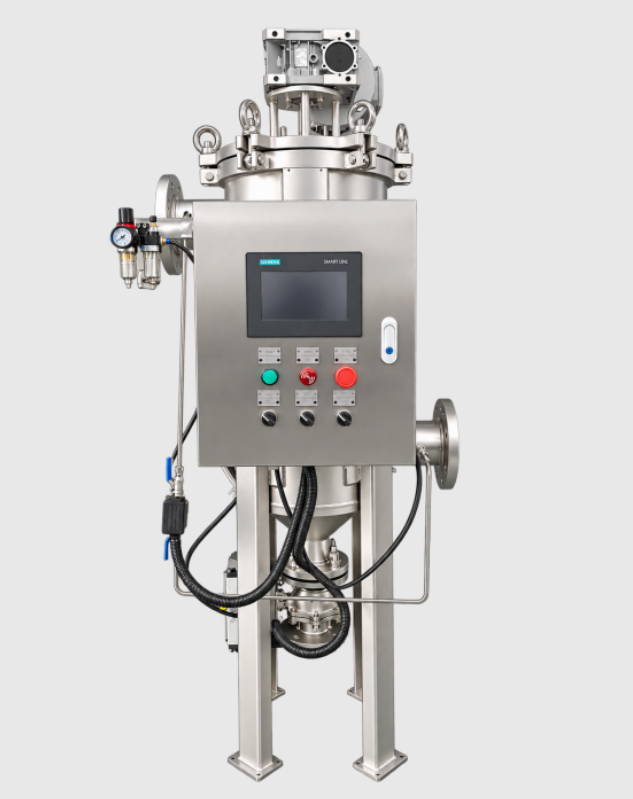
Self-Cleaning Filters can be used where particulate loading is continuous and frequent manual filter replacement would be impractical. Automatic backwashing allows the filter to continue operating while accumulated solids are removed from the filter screen.


Self-Cleaning Filters for data center liquid cooling

What Makes Data Center Cooling-Water Filtration Different

Data center cooling systems can operate continuously and handle substantial water flow. Filtration equipment therefore needs to fit into the physical layout of the facility as well as the water system itself.

For a new data center, the filter may be incorporated into the cooling-water system during the initial design. For retrofit projects, existing pipe connections, available installation space, flow requirements, and access for maintenance can place more limits on the equipment that can be used.

The same consideration applies to filter maintenance. A system with limited access may require a different filter arrangement from one where operators can easily remove and replace filter bags or cartridges.

Filtration for Cooling-Water Reuse

Cooling-water filtration is only one part of a larger water-treatment program. Depending on the facility, the system may also include chemical treatment, corrosion control, scale control, biological control, blowdown, and makeup-water management.

The role of filtration is to control suspended particulate so that solids do not continue circulating through the cooling system.

When cooling water is reused over long operating periods, removing suspended solids can reduce the amount of particulate reaching downstream equipment.

Conclusion

As AI data centers continue to increase cooling demand, facility cooling systems need to handle larger water flows and longer periods of water circulation and reuse. Suspended solids from makeup water, corrosion, and system debris can accumulate in the cooling-water loop and reach heat-transfer equipment and other components.

Data center cooling water filtration can be used on makeup water, circulating cooling water, and cooling-water reuse lines to control suspended solids. The choice between High Flow Filter Cartridges, Multi Bag Filter Housings, and Self Cleaning Filters depends mainly on flow rate and particulate loading.

relevant products

Subscribe to our blog newsletter

Get the best, coolest and latest delivered to your inbox each week

[newsletter_form]

Have Questions?

error: Content is protected !!