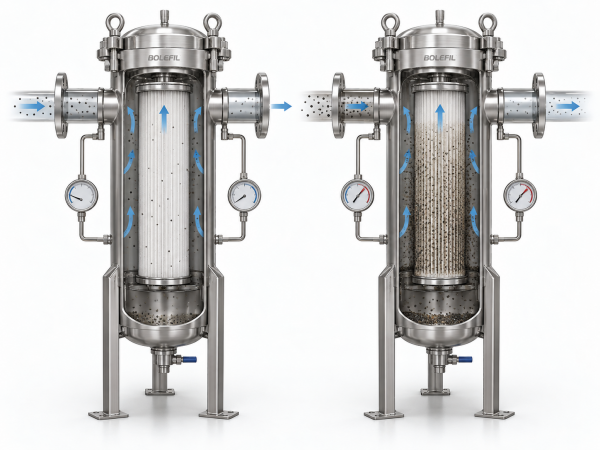

CDU filter pressure drop can change significantly as a filter moves from a clean condition to a loaded condition. That change can affect the hydraulic margin available to the rest of the liquid cooling system, particularly when the CDU is already operating close to its required flow and pressure conditions.
This is where CDU filter pressure drop needs to be considered beyond a single value on a datasheet. The pressure loss of a clean filter is only the starting condition. As the filter retains particulate, differential pressure changes, and the filtration assembly becomes a larger part of the hydraulic resistance in the TCS loop.
For CDU filter sizing, the difference between these operating conditions can affect how much pump head remains available for the rest of the cooling circuit.
Clean Pressure Drop in CDU Filter Sizing
A clean filter pressure drop describes the resistance of a new filter at a specified flow rate and test condition. It is normally one of the first values reviewed when a filter is considered for a liquid cooling application.
At this stage, the filter has not accumulated a significant amount of particulate, so the measured pressure loss primarily reflects the filter media and the flow path through the new assembly.
This value is useful when establishing the initial hydraulic condition of a CDU. The filter is installed in the same flow path as the other TCS components, so its pressure loss has to be considered alongside the resistance of piping, fittings, heat exchangers, manifolds, cold plates, valves, and other components.
The available pump head is not unlimited. If the CDU requires a defined flow rate through the TCS loop, the pressure consumed by filtration reduces the portion of the pump’s available head that can be used elsewhere in the circuit.
A low clean pressure drop can therefore provide useful hydraulic margin at the beginning of operation. It does not, however, indicate how that margin will change as the filter loads.
What Changes as a CDU Filter Loads
Once the cooling system is operating, the filter begins retaining suspended particulate. The retained material changes the flow resistance through the filter media, causing differential pressure to increase.
This is the loaded filter pressure drop.
The rate of increase is not necessarily constant throughout the filter’s service life. A filter may operate with relatively little change in ΔP during an initial period and then experience a faster increase as more particulate accumulates.
The contamination entering the system also affects the loading behavior. A CDU during initial commissioning may encounter installation debris, flushing residue, or other particulate that is not representative of the stabilized cooling loop. After commissioning, the particle load may be lower or have a different composition.
As a result, the same filter can experience different loading behavior in different applications even when its nominal filtration rating remains unchanged.