Quality Assurance
Within the chemical industry, filtration is also used for quality assurance. By closely monitoring filter performance, operators can identify variations in the feed stream’s quality and implement corrective measures before any impact on the final product quality. Additionally, filtration serves as a tool to guarantee that products adhere to designated quality standards, encompassing factors like particle size distribution, purity, and clarity.
Enhanced Efficiency and Cost-Efficiency
Utilizing filtration represents a cost-efficient strategy to enhance the effectiveness of chemical processes. Through the removal of impurities and contaminants from the feed stream, filtration contributes to heightened yields and improved final product quality. Additionally, filtration plays a role in minimizing the need for equipment cleaning and maintenance, thereby reducing downtime and bolstering overall productivity.
Common Filtration Methods Used in Chemical Plants
There’s no single filtration method that suits every chemical process. Each one has a particle size range it handles well, a chemistry it tolerates, and a cost profile. Here are the main types used in industrial chemical plants and where each one fits.
Cartridge filtration
The most widely used method in chemical liquid filtration. A replaceable filter element made of a melt-blown, pleated, or membrane, sits inside a pressure housing and removes particles from the fluid stream as it passes through. Cartridge filters are available in micron ratings from 0.1 to 100 micrometers, which covers the vast majority of liquid polishing and pre-filtration tasks in a chemical plant. They’re easy to change, they work across a wide range of chemistries, and they don’t need backwashing or regeneration. For aggressive chemicals, PTFE and PVDF membrane cartridges handle what polypropylene can’t.
Membrane filtration
Used when standard depth or cartridge filtration isn’t enough. Membrane filters work at the sub-micron level, microfiltration (0.1–10 micron), ultrafiltration (0.01–0.1 micron), and nanofiltration go progressively finer. In chemical manufacturing, membrane filtration is common in solvent purification, sterile filtration for pharmaceutical-grade chemicals, and anywhere the process needs a tight cut-off on particle size. The trade-off is cost and pressure drop; membrane systems need more careful management than depth filtration setups.
Bag filtration
Bag filters handle higher volumes of solids than cartridges and at a lower cost per unit. They’re the practical choice for bulk solid removal from large-volume process liquids, removing catalyst fines, coarse sediment, or process debris before the fluid goes downstream. A single bag filter housing can handle flow rates that would need dozens of cartridge housings. Where cartridges give you fine particle control, bag filters give you throughput.
Coalescing filtration
Specific to gas and vapour streams, and to any application where the contamination is liquid droplets or aerosols rather than solid particles. Coalescing filters capture fine liquid mist, oil aerosols, and water droplets from compressed air and process gas lines. In chemical plants, they’re installed upstream of compressors, instruments, and heat exchangers to prevent liquid carryover from causing damage or affecting readings. They also appear in gas processing lines where hydrocarbon droplet removal is a process requirement.
Vacuum and pressure leaf filtration
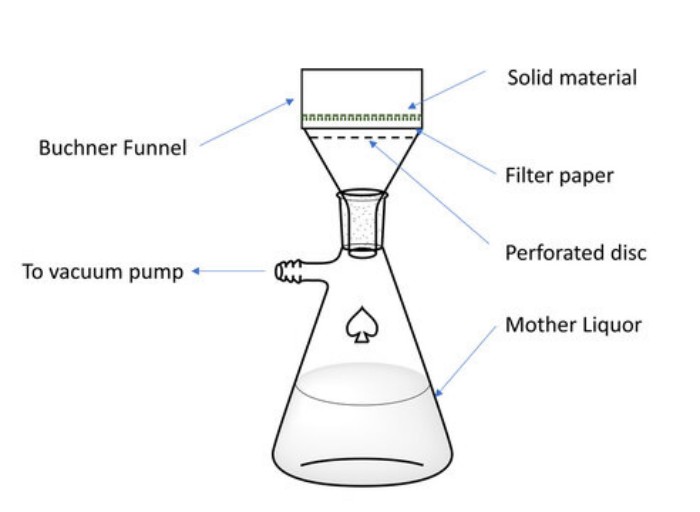
Used for catalyst recovery, pigment separation, and solid-liquid separation in slurry applications, situations where the solid phase has value and needs to be captured cleanly. Pressure leaf filters apply pressure to push the slurry through a filter medium, depositing the solid cake on the filter leaves. Vacuum filters work the same principle in reverse. These are larger, more complex systems than cartridge or bag filtration, but when you’re recovering an expensive catalyst or separating a product from its reaction mixture, they pay for themselves quickly.
Liquid Filtration Systems for Chemical Processing
Most chemical plants use a multi-stage liquid filtration system rather than a single filter type. A typical setup runs coarse pre-filtration first, bag filters or wound cartridges catching the bulk of the solids load, followed by a fine polishing stage using pleated or membrane cartridges. The pre-filter protects the expensive fine filter from blinding too quickly, which keeps change-out costs down.
For aggressive chemical service, the housings and cartridges both need to be specified for chemical compatibility. Stainless steel housings with PTFE-lined internals are common in acid and oxidising environments. Polypropylene housings work fine for lower-temperature, lower-aggression applications. Getting the materials right at the design stage saves a lot of trouble later, corroded housings and degraded cartridges are two of the most common causes of contamination incidents in chemical filtration systems.
Conclusion
Filtration holds a pivotal position in the chemical industry, being integral to the creation of top-tier products. Employed in diverse processes, including purification, clarification, separation, and product recovery, filtration stands as a key driver for enhancing the efficiency of chemical processes. Its role in removing impurities and contaminants from the feed stream not only improves process efficiency but also minimizes downtime, consequently boosting overall productivity.
Drawing upon over a decade of expertise in filtration, Brother Filtration is always your reliable business partner. Our team of professionals is dedicated to helping you complete your project. We offer comprehensive chemical filtration solutions tailored to meet the unique needs of chemical processes. Contact us now!
FAQs About Chemical Industry Filtration
Here are the most commonly asked questions for chemical industry filtration:
1. What does filtration actually do in a chemical plant?
Simply put, it pulls out whatever does not belong in your process stream – solids, liquid droplets, or gas phase contaminants. Which method you go with depends on what you are dealing with. Liquid streams typically run through cartridge or membrane filters. Gas and aerosol contamination needs coalescing or HEPA type filters. If you are separating bulk solids from a slurry, pressure leaf or vacuum filters are the ones for that job.
2. Which filter type sees the most use in chemical liquid filtration?
Cartridge filters, by a clear margin. A replaceable element made of melt blown, pleated, or membrane material sits in a pressure housing and does its job as fluid moves through. Ratings go from 0.1 right up to 100 micrometers, which covers most liquid polishing and pre filtration work you will come across in a plant. No backwashing, no regeneration. Just swap it out when it is done.
3. At what point does membrane filtration beat cartridge filtration?
Once you are working below the micron threshold. Microfiltration sits in the 0.1 to 10 micron range, ultrafiltration covers 0.01 to 0.1 micron, and nanofiltration goes tighter still. Chemical manufacturers lean on membrane filtration for solvent purification, sterile filtration of pharmaceutical grade chemicals, and any line where the particle is cut off cannot be approximated. Higher pressure drop and running costs come with the territory.
4. Bag filter vs cartridge filter – what is the real world difference?
One is built for volume, the other for precision. A single bag filter housing moves the kind of flow that would otherwise need dozens of cartridge housings. That is why they are the go to option for stripping bulk solids out of high volume process liquids. Cartridges take over when you need tighter particle control. Most plants end up running both, just at different points in the same system.
5. What is coalescing filtration and where does it fit in chemical processing?
It is designed specifically for gas and vapour streams where the contamination is liquid phase rather than solid. Think oil mist, water droplets, hydrocarbon aerosols. Chemical plants fit coalescing filters upstream of compressors, heat exchangers, and instrumentation to stop liquid carryover from causing damage or skewing readings. They also show up in gas processing lines where pulling out hydrocarbon droplets is a firm process requirement.
6. How does a pressure leaf filter work and what is it used for?
Pressure pushes the slurry through a filter medium and the solid cake builds up on the filter leaves. Vacuum filters run the same logic in the opposite direction. You will find them handling catalyst recovery, pigment separation, and solid liquid separation in slurry work. These are applications where the solid itself has value and needs to come out cleanly.
7. What filter materials actually hold up against acids and alkalis?
PTFE and PVDF membrane cartridges are the reliable choice when the chemistry gets aggressive. Polypropylene will not hold up in those conditions. For housings, stainless steel with PTFE lined internals is common where acids or oxidising agents are involved. Polypropylene housings handle the less demanding, lower temperature applications well enough. Wrong material choices at the specification stage are behind most corroded housing and degraded cartridge problems seen in chemical filtration systems.
8. What does a multi stage liquid filtration system look like in practice?
The first stage takes the heavy load. Bag filters or wound cartridges strip out the bulk of the solids. Then a pleated or membrane cartridge stage handles the fine polishing. The pre filter is doing an important job there, stopping the fine filter from blinding too quickly, which directly controls your change out costs. Both housings and cartridges need to be matched to the process chemistry, not just the particle size.
9. What is behind most contamination incidents in chemical filtration systems?
Two things keep coming up. Corroded housings and cartridges that have broken down. Nearly always the root cause is a material compatibility issue that was not caught when the system was being specified. Once the housing or cartridge starts degrading, contamination finds its way into the process stream. It is a problem that is almost entirely avoidable if the right materials are locked in at the design stage.
10. What goes wrong when the filtration method does not match the process?
More than just a quality issue. A mismatched filter setup can take a process line offline or create a compliance problem. If the micron rating is off, contamination gets through. If the materials are not compatible, you are changing filters far more often than you should be and paying for it in downtime and replacement costs. The right specification covers particle size, flow rate, chemistry, and operating pressure. Skip any of those and you will feel it later.