...
Knowledge

Industrial cooling water systems are commonly applied in manufacturing, petrochemical, and power generation industries. Their main role is to remove excess heat from equipment and maintain stable operating temperatures during continuous production.

In most systems, cooling water circulates in a closed or semi-open loop. Over time, the water carries suspended solids, rust particles, sand, algae, and pipe scale.

These particles gradually build up in the system and affect performance. Heat exchangers and nozzles are usually the first to show signs of fouling or blockage, while conventional filters often require frequent cleaning or replacement during operation. This is where self-cleaning filters become more widely applied.

Why Self-Cleaning Filters Are Used in Industrial Cooling Water Systems

Common Problems in Industrial Cooling Water Systems

Cooling water systems run continuously and handle large water volumes, so contamination can come from several sources. It may enter through raw water, be generated by internal corrosion, or be introduced from dust, biological growth, and process carryover.

Once inside the system, these particles circulate repeatedly and gradually build up in key components.

Heat exchanger fouling

Even a relatively thin layer of sediment or scale on heat transfer surfaces can reduce efficiency. In practice, this leads to higher energy demand to maintain the same cooling output.

Blocked nozzles and uneven distribution

Cooling towers and spray systems depend on uniform water distribution. When nozzles become partially blocked, flow distribution becomes uneven, and overall cooling performance drops.

Increased mechanical wear

Hard particles circulating through pumps, valves, and piping systems contribute to erosion and mechanical wear, especially in long-term operation.

Common Problems in Industrial Cooling Water Systems

Higher energy consumption

As system resistance increases and heat transfer efficiency drops, pumps and chillers often operate under higher load conditions to compensate.

Unplanned shutdowns

Cleaning clogged filters or servicing fouled equipment often requires stopping part or all of the system, which directly affects production continuity.

Limitations of Traditional Filtration Systems

Conventional filtration equipment is still widely used in cooling water treatment, but each type has operational constraints in continuous industrial environments.

Bag filters

Bag filters are simple and cost-effective at installation. However, they rely on disposable filter bags that need frequent replacement.

In high-solid-content water systems, replacement intervals can become very short, leading to increased maintenance workload and downtime.

Basket strainers

Basket strainers are commonly installed for coarse filtration. They are mechanically simple but require manual cleaning.

Each cleaning cycle involves system shutdown, opening the housing, removing the basket, and clearing accumulated debris before reassembly.

Cartridge filters

Cartridge filters offer higher filtration precision, but in cooling water systems with heavy suspended solids, they tend to clog quickly. This results in frequent replacement and rising operating costs.

As industrial systems move toward continuous and automated operation, these limitations become more noticeable.

What Is a Self-Cleaning Filter?

A self-cleaning filter is basically a system that cleans itself while the water is still running, so you don’t need to stop the flow.

Instead of opening the filter and cleaning it manually, the system just keeps an eye on the pressure drop across the filter. When it gets too high, it automatically starts a cleaning cycle.

Different designs handle cleaning in different ways — some use backwashing, some use suction scanning, others use brushes or scrapers.

During cleaning, the dirt stuck on the filter surface is removed and flushed out through the drain, while the system keeps filtering as normal.

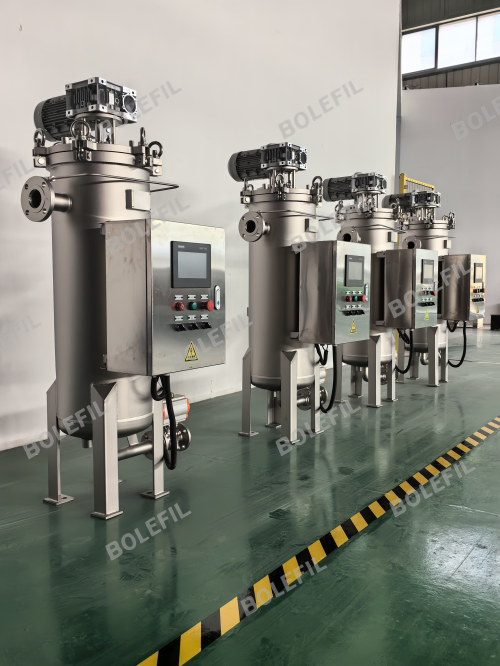
what is self cleaning filter

Key Advantages in Cooling Water Applications

In cooling water systems, these benefits are mainly reflected in day-to-day operation. The filter doesn’t just remove solids — it helps keep the whole system running more steadily with less manual attention.

Continuous operation

The filtration and cleaning processes run in parallel. There is no need to stop the system during cleaning cycles, which supports continuous industrial operation.

Lower maintenance demand

Since cleaning is automatic, manual intervention is significantly reduced. Operators spend less time on routine filter servicing and consumable replacement.

More stable heat exchange performance

By reducing suspended solids in the circulating water, heat exchanger surfaces remain cleaner, helping maintain consistent thermal performance.

Reduced equipment stress

Cleaner water conditions help limit abrasion and fouling in pumps, valves, chillers, and pipelines, which supports more stable long-term operation.

Cleaner water conditions help limit abrasion and fouling in pumps, valves, chillers, and pipelines, which supports more stable long-term operation.

Adaptability to industrial environments

Self-cleaning filters are usually made of carbon steel or stainless steel, so they can work in pretty different water conditions and industrial setups without much issue.

Typical Applications

Self-cleaning filters are used across many cooling water-related systems where continuous operation is required.

Cooling tower systems

Cooling towers are exposed to airborne dust and biological contaminants. Self-cleaning filtration helps control suspended solids before they enter downstream equipment.

Heat exchanger protection

Installing a self-cleaning filter upstream of heat exchangers helps reduce fouling and supports stable heat transfer efficiency.

Chilled water and HVAC systems

In building and industrial HVAC systems, stable water quality helps maintain consistent cooling performance and reduces maintenance frequency.

Petrochemical plants

Large-scale cooling loops in petrochemical facilities often carry corrosion products and process-related particles. Continuous filtration helps maintain stable operation.

Power generation systems

Cooling reliability is critical in power plants. Self-cleaning filtration helps reduce unplanned maintenance and supports continuous operation of key systems.

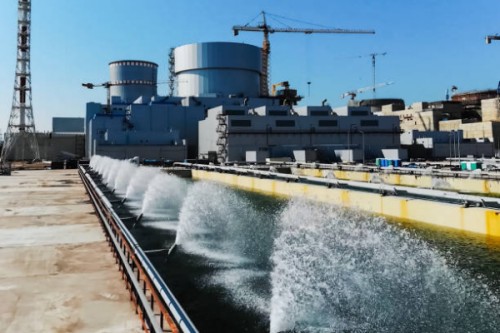
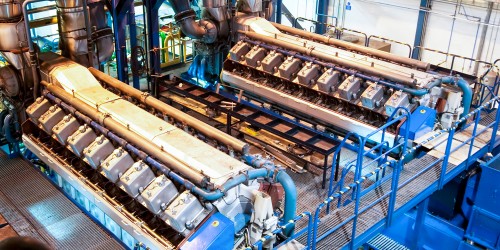
self cleaning filter used in power plants

Steel and metal processing

In dusty and heavy-duty environments, cooling water contamination levels are typically higher, requiring robust and continuous filtration solutions.

How to Select a Suitable Self-Cleaning Filter

Selection depends on actual operating conditions rather than a single parameter.

Flow capacity

The filter must match system flow requirements to avoid unnecessary pressure loss.

Filtration rating

Cooling water applications typically use filtration levels between 50 and 500 microns, depending on equipment sensitivity and water quality.

Water quality conditions

Suspended solids concentration and particle size distribution directly affect cleaning frequency and filter sizing.

Material selection

Carbon steel is commonly used for standard industrial systems, while stainless steel is preferred for more corrosive environments.

Cleaning mechanism

Different systems may require backwash, brush, or scraper-type cleaning depending on particle type and contamination level.

Operational Cost Considerations

In industrial cooling systems, filtration performance is closely linked to long-term operating cost.

Conclusion

Cooling water systems run continuously and are quite sensitive to water quality. Once contamination is not well controlled, it quickly shows up in heat transfer performance and puts more load on equipment, which also means higher operating cost over time.

Conventional filters do the basic job, but they still need regular cleaning, and the system usually has to be stopped when you service them. Self-cleaning filters work differently by removing solids automatically during operation, which makes them a better fit for systems that need stable, continuous running with less maintenance effort.

BOLEFIL provides self-cleaning filtration solutions for industrial cooling water applications. We support selection based on flow conditions, filtration requirements, and actual operating environments.

relevant products

Subscribe to our blog newsletter

Get the best, coolest and latest delivered to your inbox each week

Have Questions?