Why Multi-Stage Filtration Is Essential for Modern Data Centers?
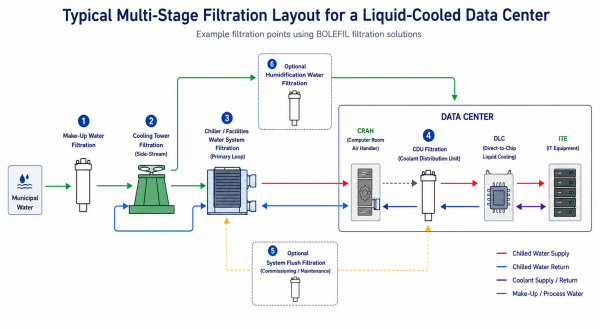
Contamination in a liquid-cooled data center doesn’t come from one place – it builds up across the whole system, and each source is different. Make-up water can carry in suspended solids. Cooling towers stay exposed to airborne debris and biological growth around the clock. Closed loops slowly develop corrosion products and pipe scale over months and years. And during commissioning or maintenance, welding residue and construction debris get introduced too.
Because these contaminants come from different places and range wildly in particle size, one filter can’t cover all of it. A filter sized to catch large debris at the cooling tower won’t give a CDU secondary loop the fine control it needs. Go the other direction – put a fine filter too early in the system – and you get higher pressure drop, shorter filter life, and upstream equipment left unprotected.
Multi-stage filtration solves this by matching filter performance to what each stage is actually dealing with. Bigger particles get removed early. As water moves toward more sensitive equipment, the filtration gets progressively finer to handle smaller contaminants and give that equipment the level of protection it needs.
FAQs
What is data center water treatment?
It’s the filtration and treatment process applied throughout a liquid cooling system from make-up water through the cooling tower, primary loop, and CDU secondary loop to keep coolant clean enough to protect heat exchangers, pumps, valves, and cold plates.
Why can’t one filter protect the whole cooling system?
Because contamination varies by location. Make-up water carries sand and rust, cooling towers pick up airborne debris and biological growth, and closed loops develop corrosion products and scale. A filter sized for one of these won’t handle the others without sacrificing either protection or flow.
What micron rating is used for CDU secondary loop filtration?
Typically 1–10 μm, though some systems run up to 25 μm depending on cold plate design. This is the finest filtration stage in the system since it protects the smallest flow channels.
What contaminants does cooling tower side-stream filtration remove?
Mainly dust, silt, biological matter, and corrosion products that enter through exposure to the outside environment. Side-stream filtration runs continuously without interrupting overall system flow.
Do I need filtration during commissioning?
Yes. New installations typically carry welding slag, pipe scale, and construction debris that need to be flushed out with temporary cartridge or bag filters, usually starting coarse and stepping down in micron rating as the flush progresses.
How often should facility water system filters be replaced?
It depends on water quality and system load, but a rising pressure drop across the filter is usually the clearest sign it’s due for replacement, rather than sticking to a fixed calendar interval.
What’s the difference between a cartridge filter and a bag filter for make-up water?
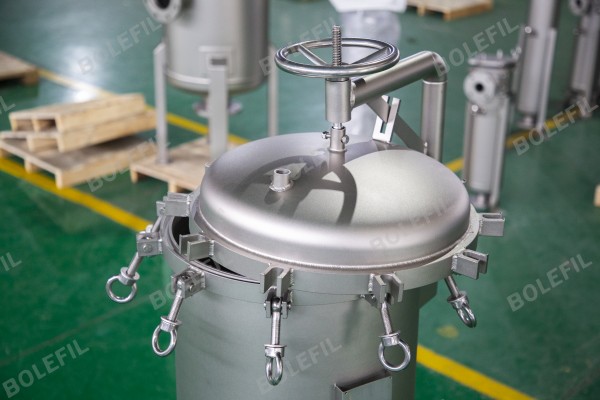
Both handle similar micron ranges (5–50 μm), but cartridge filters generally offer more consistent filtration performance, while bag filters tend to hold more debris before needing a change. The right choice depends on water volume and contamination levels at your site.
Conclusion
A single filtration point isn’t enough for a modern liquid-cooled data center. A complete water treatment approach covering make-up water through to the CDU secondary loop makes sure every part of the system gets the protection it’s actually built to need. That translates into less fouling, better heat transfer efficiency, and a cooling infrastructure that holds up over the long run.
BOLEFIL builds complete filtration solutions for liquid-cooled data centers, and helps customers match the right filtration technology to each stage of the cooling water system. Not sure which filter rating or technology fits your setup? Talk to our filtration team for a recommendation built around your system, whether you’re planning a new installation or upgrading an existing one.