The Filtration Duty Can Change With System Operation
Filtration requirements can differ between commissioning and normal operation.
A new TCS loop can carry debris left from installation, assembly, or system flushing. Filtration during this stage is intended to remove this material before the system moves into normal operation. A temporary filter is often used for the initial flushing work and can be removed or replaced once the loop has been cleaned.
Once the system is in operation, the filtration duty changes. The focus is on keeping the coolant clean and removing particles that enter the loop or are generated during operation. Particle contamination can also contribute to cold plate fouling and restrict coolant flow.
The filter used for flushing does not have to be the same filter used afterward. The two stages can call for different filter configurations based on the flow being treated and the amount of particulate in the system.
The Housing Is Part of the Filtration Assembly
The filter element is only one part of the filtration assembly.
The housing provides the flow path around the filter element. Its internal volume and flow passages add to the pressure drop of the assembly, while the inlet and outlet arrangement determines how coolant moves through the housing.
The housing also needs to allow for element replacement, isolation, and routine maintenance within the available installation space. Seals, valves, and the element retention method form part of the same assembly.
The filter element itself may meet the required filtration rating and pressure-drop target, while the complete assembly still requires changes to the housing or internal flow arrangement for the final application.
Prototype Conditions May Not Represent the Production Design
Filtration requirements can change as a CDU design moves from testing to production.
An early prototype is not always tested under the same conditions planned for the production unit. The flow rate, connections, and filtration setup may change as the CDU design is developed.
The filtration assembly should be reviewed against the final operating conditions before the production configuration is established.
When filtration is integrated into a packaged CDU or TCS skid, the filtration assembly needs to match the hydraulic path, connection arrangement, service access, and maintenance procedure. BOLEFIL provides filtration solutions for TCS cooling circuits, including filter cartridges and assemblies configured for the required flow, filtration rating, and installation arrangement.
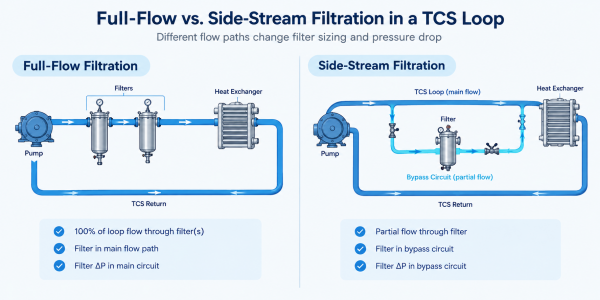
Full-Flow and Side-Stream Require Different Design Inputs
The same filtration rating can be used in either arrangement, but the design conditions for TCS loop filtration are different.
For a full-flow configuration, relevant inputs include:
- TCS design and operating flow rate
- Available pressure-drop budget
- Coolant type and concentration
- Operating temperature and pressure
- Required filtration rating
- Expected particle loading
- Connection size and configuration
- Element replacement or cleaning requirements
A side-stream configuration uses the same basic operating information, with the bypass flow rate as an additional design parameter. The bypass connection also has to provide enough pressure for the selected side-stream flow. Where the filtered flow returns to the TCS loop is part of the system layout.