


Reverse osmosis desalination systems are machines that clean salty or dirty water by pushing it through a special filter. This filter removes salt, germs, and other harmful particles, letting only clean water pass through.
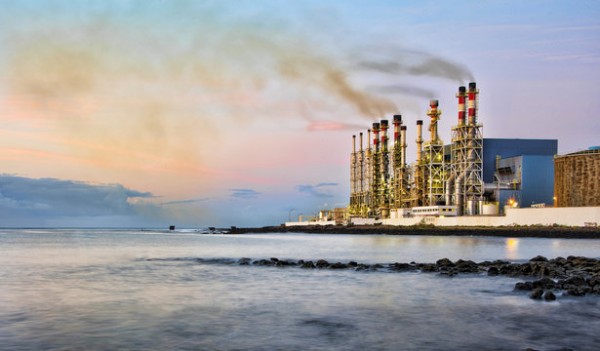
If you’ve ever wondered how desert countries get safe drinking water, this technology is a big reason why. Today, reverse osmosis is the most common way to turn seawater into freshwater, making almost 70% of the world’s desalinated water. It uses less energy than older methods, works for both small and large water plants, and can remove more than 99% of salt and contaminants.
With more than 21,000 plants running around the world today, these systems are no longer just a backup plan. As water becomes harder to find in places like the Middle East, Asia, and Australia, these plants have become a necessary part of everyday life. Here’s exactly how they work, what each stage does, and what actually matters when you’re evaluating one.
Key Filtration Equipment in an RO Desalination System
Every stage of the RO desalination process depends on reliable filtration components. Below is a breakdown of the critical equipment used across the system, with the function of each component explained.
Pre-Filters: Sediment and Depth Filter Cartridges
Sediment pre-filters are the first layer of protection in any RO system. They remove dirt, sand, rust, and other tiny particles from the water before it reaches the main membrane. Depth filter cartridges, can be made in different ways, like melt-blown or wound, and they come in different sizes from 5 to 100 microns. Inadequate pre-filtration is the most common cause of RO membrane fouling and premature failure.
Pleated Pre-Filters for High-Flow Applications
Where higher flow rates or tighter micron ratings are required ahead of the membrane, pleated filter cartridges offer greater surface area and lower pressure drop than depth cartridges. Membrane pleated filters (0.1–1 micron) are used in the final pre-filtration stage for systems requiring microbiological reduction before the RO membrane. Their higher dirt-holding capacity reduces change-out frequency in demanding seawater environments.
High-Pressure Filter Housings and Membrane Vessels
High-pressure filter housings contain the RO membrane elements and must withstand operating pressures of 55–70 bar for seawater applications. Housings are typically manufactured from fibreglass-reinforced plastic (FRP) or stainless steel and sized to accommodate 4-inch or 8-inch diameter membrane elements in series. Correct housing selection ensures structural integrity, minimises bypass, and provides safe membrane access for maintenance.
Post-Treatment and Polishing Filters
After the RO membrane, membrane filter cartridges (typically 0.1 – 0.45 micron absolute-rated) are used in post-treatment polishing to ensure final water quality meets the required purity standard. In industrial and pharmaceutical applications, a final, absolute-rated membrane cartridge provides a validated microbial barrier before distribution. For drinking water production, these are installed after remineralisation to capture any particulate introduced during post-treatment.
High-Flow Filter Cartridges for Large-Scale Systems
Municipal and large industrial desalination plants use high-flow filter cartridges to minimise housing count and reduce system footprint. High-flow cartridges handle flow rates up to 400 LPM per cartridge. A single housing can replace banks of standard 10-inch cartridges, making them cost-effective for large pre-filtration skids. Their extended service life and reduced maintenance frequency are significant advantages in remote or offshore installations.
UF/RO Membranes
The RO membrane is the core separation element of the system. Spiral-wound thin-film composite (TFC) membranes reject dissolved salts, heavy metals, and biological contaminants at rates exceeding 99%. For applications where a pre-treatment RO stage is needed, or where ultrafiltration is used upstream to reduce the SDI (Silt Density Index) of the feed water, UF membranes provide a consistent, low-fouling feed to the main RO elements.
What is seawater reverse osmosis?
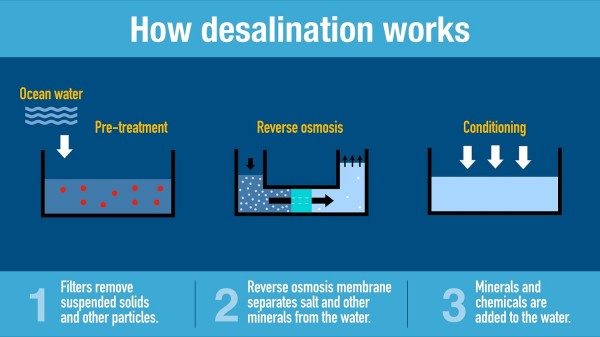
Seawater reverse osmosis (SWRO) is a desalination process that pushes seawater through a semipermeable membrane under high pressure, separating dissolved salts and contaminants from water molecules to produce clean, drinkable freshwater.
To get why that works, you first need to understand what it’s pushing against. Water naturally wants to move toward saltier water; that’s basic osmosis, two sides of a membrane trying to even themselves out. Reverse osmosis fights that. Apply sufficient external pressure on the salty side, and that natural pull gets overpowered, sending water molecules through the membrane in the opposite direction while the salts stay behind.
What comes through the membrane is called permeate, that’s your clean water. What doesn’t make it through is called brine or concentrate, a saltier, more concentrated solution that gets discharged separately.
The pressure required varies depending on how salty your source water is. Open-ocean seawater requires between 800 and 1,000 psi (55–85 bar) to flow through. Brackish water from inland wells or estuaries, which contains far less salt, only requires around 250-400 psi (17–28 bar). That difference in pressure is exactly why brackish water systems are cheaper to operate day to day.
How Does a Seawater Reverse Osmosis Desalination Treatment System Work? A Step-by-Step Guide
Reverse osmosis desalination converts seawater into clean, usable water through a series of controlled filtration and pressure stages. Each step below explains what happens to the water and what equipment drives the process.
Step 1: Seawater Intake
Raw seawater is drawn from the sea via intake screens or subsurface wells. Intake screens remove large debris, marine life, sediment, and floating matter before the water enters the treatment system. Subsurface intakes offer better pre-filtration naturally through sand layers.
Step 2: Pre-Filtration (Suspended Solids Removal)
The water passes through multi-stage pre-filters: typically a sediment depth filter cartridge followed by a carbon filter or multimedia filter. These remove suspended solids, turbidity, chlorine, and organic matter that would otherwise foul or degrade the RO membrane. Pre-filter housings and cartridges must be sized to match the system’s flow rate.
Step 3: High-Pressure Pump
A high-pressure pump pressurises the pre-filtered seawater to between 55 and 70 bar (800–1,000 psi) for seawater applications, or 10–15 bar for brackish water. This pressure must overcome the natural osmotic pressure of the seawater and force water molecules through the membrane. Energy recovery devices are fitted to many modern systems to recapture pressure energy from the concentrate stream, reducing power consumption by up to 60%.
Step 4: RO Membrane Separation
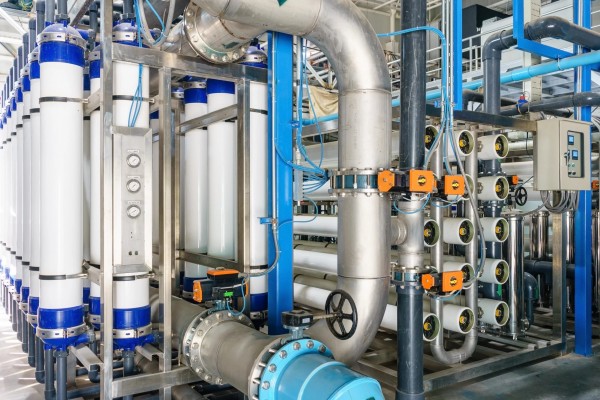
The pressurised water enters spiral-wound RO membrane elements housed in high-pressure vessels. The semi-permeable membrane allows only water molecules to pass through, rejecting dissolved salts, heavy metals, bacteria, and other contaminants at rates exceeding 99%. The output splits into two streams: the permeate (clean freshwater, typically <500 ppm TDS) and the concentrate (brine), which is returned to the sea via a diffuser.
Step 5: Post-Treatment and Remineralisation
Permeate water is very pure but slightly acidic and low in minerals. Post-treatment adds calcium and magnesium back through a remineralisation filter (typically calcite or dolomite media) and adjusts pH to bring the water within drinking water standards. Disinfection via UV or chlorination is applied as a final step before distribution.
Step 6: Distribution
The treated water enters storage tanks or is pumped directly into the distribution network. Continuous monitoring of TDS, pH, conductivity, and flow rate ensures consistent output quality. Many industrial RO systems incorporate SCADA controls for automated monitoring and fault detection across all stages.
What are the advantages of seawater treatment?
Most of the arid and severely water-scarce regions (such as the Middle East, the southern United States, Australia, etc.) have widely used seawater treatment systems to better meet the water needs of local people’s life and production. The seawater desalination process can effectively remove about 3% of the salt in seawater. Seawater desalination has the following advantages:
Modular system
Seawater treatment is mostly a modular system, the compact design of the system can save economic costs, and it is easy to install and move. Ideal for municipal or commercial potable water applications, providing large volumes of usable water while saving space.
Effectively increase drinking water source
The current water source situation is very worthy of attention, not only to protect water use but more importantly, to increase available water resources. With more than 95% of all water on Earth, the ocean happens to be a very good choice as an available resource for drinking water.
Higher water production
There is another way of desalination treatment is a thermal variant. Its working principle is similar to the water circulation system, which evaporates water and then condenses it to produce clean water. This method can effectively remove unwanted particulate matter, but the work efficiency is low, and the amount of pure water produced is not as much as the RO system.
Producing very pure water
The water after reverse osmosis treatment is very pure. And we also need to put the minerals in the water that people need back into the water, which involves the process of remineralization, which can also be used to adjust the pH of the water.
The disadvantages of seawater treatment
The advantages of the seawater treatment system are so obvious that clean and safe water can be obtained very well, so why do some places still not use the system? Precisely because of some limitations of its system:
Pretreatment needed
The reverse osmosis membrane is relatively fragile, and it is easy to cause membrane fouling, which affects the performance and shortens the life span. It is very necessary to pretreat seawater, which can filter out some larger pollutants and impurities and reduce the loss of membranes.
Higher energy use
The reverse osmosis system will continuously pump seawater, pressurize, and force seawater into the membrane container, which is a constant flow process. In some systems, the necessary pressure can even be as high as 1000 psi (69 bar). In reality, it is possible to retrieve the osmotic pressure energy that has been stored in the concentrate, which lowers the overall cost of energy.
Cost too high for developing countries
Many developing countries do not have the ability, resource construction, and operating costs to carry out seawater desalination system projects. Moreover, the seawater desalination process also needs to consume a lot of economic costs to operate. Compared with the treatment costs of groundwater and other surface water sources, marine treatment systems are obviously more expensive.
Reverse Osmosis vs Thermal Desalination: Efficiency and Cost Comparison
The two main desalination technologies differ significantly in energy consumption, water recovery, and ideal use case. The table below provides a direct technical comparison to help engineers and procurement teams select the right system.
| Parameter | Reverse Osmosis | Thermal Desalination |
|---|---|---|
| Energy Use (kWh/m³) | 2–4 kWh/m³ (modern systems) | 10–15 kWh/m³ |
| Water Recovery Rate | 35–50% (SWRO) | Up to 65% (MED/MSF) |
| Typical Capacity | Up to 400,000 m³/day | Up to 1,000,000 m³/day |
| Maintenance Requirements | Membrane replacement (2–5 yrs); chemical cleaning | Scale/corrosion control; heat exchanger maintenance |
| Feed Water Suitability | Any salinity; best <45,000 ppm | High-salinity or brackish water |
| Water Purity Output | Very high (permeate <500 ppm TDS) | High, but not as pure as RO |
| Capital Cost | Lower CAPEX | Higher CAPEX |
| Best For | Coastal/municipal, industrial, offshore | Co-generation plants, very high salinity sources |
For most coastal industrial installations where energy cost is a primary concern, reverse osmosis is now the default choice. Thermal desalination retains advantages in cogeneration settings where waste heat is available, or where feed water salinity exceeds the practical range for RO membranes.
Where are desalination systems becoming increasingly popular?
Reverse osmosis desalination systems are widely used in coastal cities, arid regions, and islands where natural freshwater resources cannot meet growing demand. The Middle East and North Africa have the largest share of installed global capacity; Saudi Arabia, the UAE, Israel, Qatar, and Kuwait all rely heavily on it. We can take Israel as a clear example because the country now covers more than 85% of its domestic water needs through desalination, primarily through SWRO plants along the Mediterranean coast.
Outside MENA, adoption has been steadily climbing across coastal India, China, Spain, Australia, and island communities throughout the Caribbean and Pacific. Industrially, the technology is standard in power plants, oil refineries, pharmaceutical manufacturing, and food processing, wherever high-quality water is required.
Smaller units are also widely used on commercial and military vessels, offshore platforms, and in emergency humanitarian operations where reliable water access has been disrupted.
Conclusion
Seawater desalination mainly uses reverse osmosis technology to separate water molecules from seawater to obtain pure water. The advantages of desalination are significant and many industrial and commercial production activities benefit from it, such as power plants, oil fields, and other industrial uses.
Brother Filtration offers a variety of filtration solutions and has more than 15 years of experience in the water treatment industry. You can trust us at any time and get in touch with us right away because we offer professional technical guidance and high-quality service.
relevant products


Subscribe to our blog newsletter
Get the best, coolest and latest delivered to your inbox each week
[newsletter_form]