...
Knowledge

Liquid cooling has become the default choice for high-density AI and HPC data centers, and that shift has put data center water treatment squarely on the priority list. Water moves heat far more efficiently than air does, but it also brings maintenance requirements that air-cooled systems never had to deal with. Clean cooling water is what keeps heat exchangers, CDUs, valves, and piping free of fouling and buildup.

Contamination doesn’t show up the same way in every part of the system, which is why filtration gets applied at several points instead of one. Each stage is solving a different problem and needs a different type of filter to do it.

Data Center Liquid Cooling Systems

What is Data Center Liquid Cooling Water System?

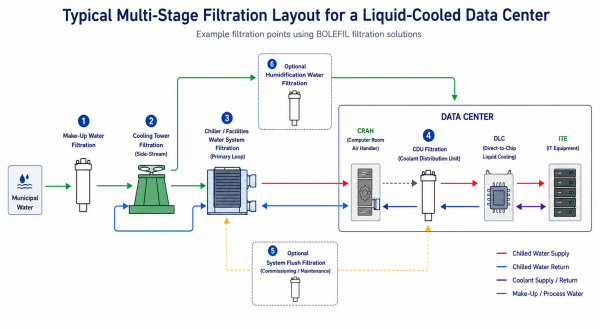
Liquid-cooled data centers run on a closed cooling water system built to pull heat away from dense server racks and AI hardware. That heat comes out in stages: water moves through the cooling tower, the chiller, the primary loop, and finally the CDU. Since each of these sections operates under different conditions, the water quality needed at each one isn’t the same either.

It starts with make-up water, which tops off the system and replaces whatever’s lost along the way. From there, water passes through the cooling tower and chiller before reaching the Facilities Water System, or primary loop. That water then feeds each Coolant Distribution Unit, where heat transfers into a separate secondary coolant loop, the one that actually runs through cold plates on the CPUs, GPUs, and other hot components.

Every section faces a different contamination profile. Cooling towers sit exposed to dust, airborne particles, and biological growth from the surrounding environment. Closed loops, by contrast, tend to accumulate corrosion by-products, scale, and welding residue left over from installation or years of operation. Since the risks differ by location, so does the filtration needed to manage them.

That’s the core reason filtration shows up at multiple points throughout the cooling system; it stops particles before they reach pumps, heat exchangers, valves, CDUs, and cold plates, where they’d otherwise cause real damage.

Multi-Stage Filtration Throughout the Liquid Cooling Water System

Water quality challenges aren’t uniform across a liquid-cooled data center. Contaminants come from different sources at different stages, and no single filter can handle all of them. A multi-stage filtration strategy lets each section of the liquid cooling system get protection matched to what it’s actually exposed to.

Multi-Stage Filtration Throughout the Liquid Cooling Water System

Stage 1 – Make-Up Water Filtration

Every cooling system starts here. Suspended solids, sand, and rust particles that enter with make-up water don’t just sit still – they circulate through the entire system if nothing stops them at the source. Filtering at this stage keeps that contamination from ever reaching downstream equipment.

Stage 2 – Cooling Tower Side-Stream Filtration

The cooling tower takes the brunt of environmental exposure. Airborne dust, organic debris, algae, and corrosion products all find their way into the circulating water during normal operation. Side-stream filtration deals with this without shutting anything down; it pulls off a portion of flow continuously and keeps both the tower and the equipment connected to it cleaner over time.

Stage 3 – Facilities Water System Filtration

The primary loop runs as a closed circuit, but “closed” doesn’t mean “clean.” Corrosion by-products, scale, and fine welding debris still turn up here, especially right after commissioning or a maintenance job. Filtering the primary loop keeps that material away from pumps, heat exchangers, control valves, and CDUs.

Stage 4 – CDU Secondary Loop Filtration

The CDU is where heat moves from the primary loop into the secondary loop that actually serves the CPUs and GPUs. Cold plates run on very small flow channels, so fine filtration here isn’t optional – it’s what prevents particle buildup and keeps coolant clean enough for reliable performance.

Because the secondary loop runs coolant directly through cold plates, it typically needs the finest filtration of any point in the system.

The CDU transfers heat from the primary loop to the secondary liquid cooling loop that serves CPUs and GPUs.

How to Choose Right Filtration Solution for Each Stage?

Every filtration point does a different job. A filter that works well in a cooling tower won’t give a CDU secondary loop the protection it actually needs. Here’s how filtration typically breaks down by stage:

System Location Primary Contaminants Typical Filter Rating Typical Filtration Technology
Make-Up Water Sand, suspended solids, rust 5–50 μm Cartridge Filter or Bag Filter
Cooling Tower Side-Stream Dust, silt, biological matter, corrosion products 20–75 μm Automatic Self-Cleaning Filter or Bag Filter
Facilities Water System (Primary Loop) Corrosion products, pipe scale, fine particulate 5–25 μm Cartridge Filter
CDU Secondary Loop Fine particulate, metallic debris, seal material 1–10 μm (up to 25 μm depending on system design) Precision CDU Filter
System Flush (Commissioning) Welding slag, pipe scale, construction debris 25–100 μm (progressively reduced during flushing) Temporary Cartridge or Bag Filter
Every filtration point serves a different purpose within the cooling system.

Why Multi-Stage Filtration Is Essential for Modern Data Centers?

Contamination in a liquid-cooled data center doesn’t come from one place – it builds up across the whole system, and each source is different. Make-up water can carry in suspended solids. Cooling towers stay exposed to airborne debris and biological growth around the clock. Closed loops slowly develop corrosion products and pipe scale over months and years. And during commissioning or maintenance, welding residue and construction debris get introduced too.

Because these contaminants come from different places and range wildly in particle size, one filter can’t cover all of it. A filter sized to catch large debris at the cooling tower won’t give a CDU secondary loop the fine control it needs. Go the other direction – put a fine filter too early in the system – and you get higher pressure drop, shorter filter life, and upstream equipment left unprotected.

Multi-stage filtration solves this by matching filter performance to what each stage is actually dealing with. Bigger particles get removed early. As water moves toward more sensitive equipment, the filtration gets progressively finer to handle smaller contaminants and give that equipment the level of protection it needs.

Conclusion

A single filtration point isn’t enough for a modern liquid-cooled data center. A complete water treatment approach covering make-up water through to the CDU secondary loop makes sure every part of the system gets the protection it’s actually built to need. That translates into less fouling, better heat transfer efficiency, and a cooling infrastructure that holds up over the long run.

BOLEFIL builds complete filtration solutions for liquid-cooled data centers, and helps customers match the right filtration technology to each stage of the cooling water system. Not sure which filter rating or technology fits your setup? Talk to our filtration team for a recommendation built around your system, whether you’re planning a new installation or upgrading an existing one.


FAQs

What is data center water treatment?

It’s the filtration and treatment process applied throughout a liquid cooling system from make-up water through the cooling tower, primary loop, and CDU secondary loop to keep coolant clean enough to protect heat exchangers, pumps, valves, and cold plates.

Why can’t one filter protect the whole cooling system?

Because contamination varies by location. Make-up water carries sand and rust, cooling towers pick up airborne debris and biological growth, and closed loops develop corrosion products and scale. A filter sized for one of these won’t handle the others without sacrificing either protection or flow.

What micron rating is used for CDU secondary loop filtration?

Typically 1–10 μm, though some systems run up to 25 μm depending on cold plate design. This is the finest filtration stage in the system since it protects the smallest flow channels.

What contaminants does cooling tower side-stream filtration remove?

Mainly dust, silt, biological matter, and corrosion products that enter through exposure to the outside environment. Side-stream filtration runs continuously without interrupting overall system flow.

Do I need filtration during commissioning?

Yes. New installations typically carry welding slag, pipe scale, and construction debris that need to be flushed out with temporary cartridge or bag filters, usually starting coarse and stepping down in micron rating as the flush progresses.

How often should facility water system filters be replaced?

It depends on water quality and system load, but a rising pressure drop across the filter is usually the clearest sign it’s due for replacement, rather than sticking to a fixed calendar interval.

What’s the difference between a cartridge filter and a bag filter for make-up water?

Both handle similar micron ranges (5–50 μm), but cartridge filters generally offer more consistent filtration performance, while bag filters tend to hold more debris before needing a change. The right choice depends on water volume and contamination levels at your site.

relevant products

Subscribe to our blog newsletter

Get the best, coolest and latest delivered to your inbox each week

Have Questions?

error: Content is protected !!