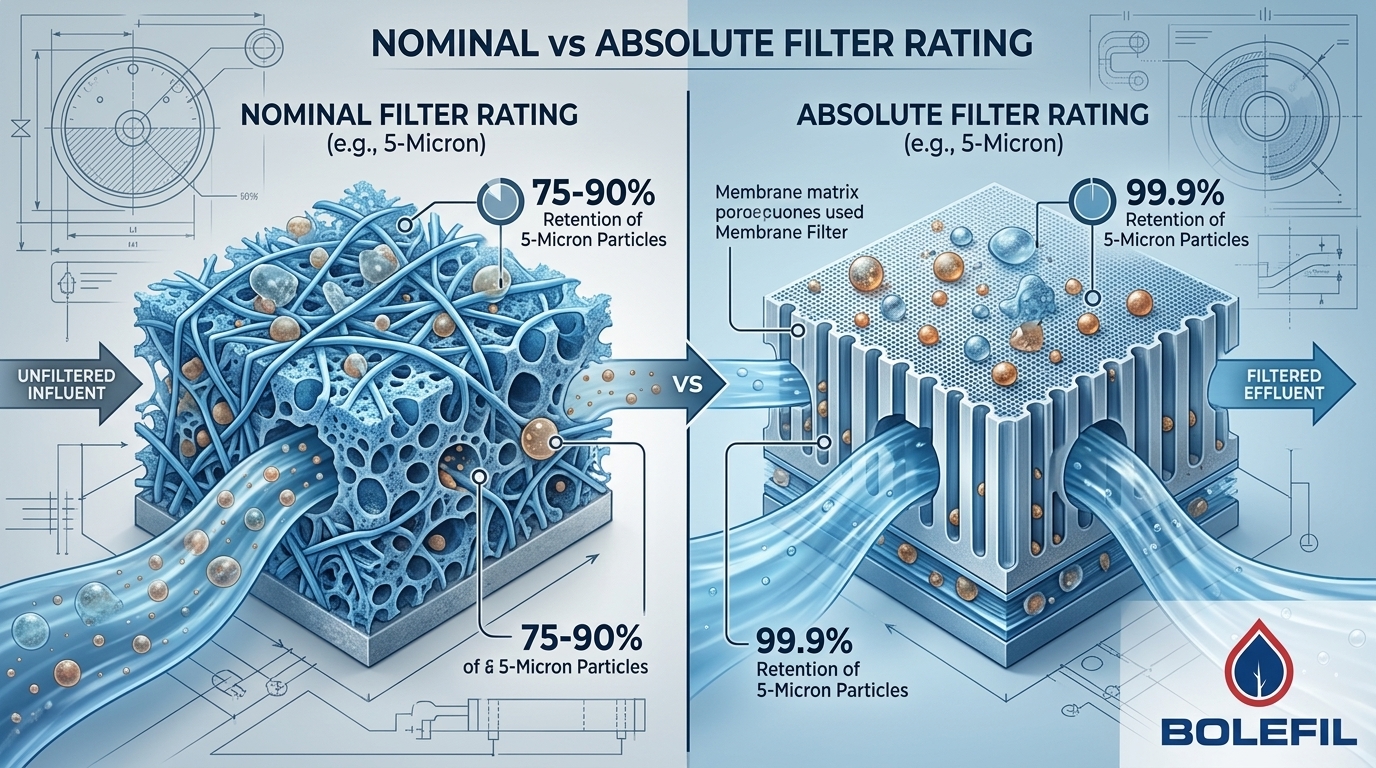
This scenario comes up more often than you’d think. You’re looking at filter products, and you see both nominal and absolute ratings sitting right next to each other on the shelf. The problem is, those two ratings describe very different things. Pick the wrong one for your application and you could be looking at equipment damage, product failure, or a compliance audit that doesn’t go your way.
Getting clear on the difference means you can choose the right filter from the start and avoid the kind of downtime and cost that nobody budgets for. Let’s start at the beginning.
A nominal filter rating tells you the approximate size of particles the filter is built to catch but that’s all it promises. A filter marked as 10 micron nominal is expected to remove most particles at or above that size under standard test conditions. That said, some particles near that threshold can still pass through.
The word to hold onto is approximate. The pores inside nominal filter media aren’t perfectly uniform. Some run a bit wider than the rated size, some a bit narrower. That inconsistency means a portion of particles often somewhere between 5 and 15 percent at the stated micron size can slide right through without getting caught.
Nominal filters typically land between 85 and 95 percent efficiency at their rated micron size. That sounds solid until you run the math on what a 5 percent bypass rate adds up to over time in an application with tight contamination limits.
A big reason many filter manufacturers lean toward nominal ratings is cost. The pore size doesn’t need to be held to the same tight tolerances as absolute filter media, which keeps production simpler and prices lower. For the right applications, that tradeoff makes total sense.
Example: A 10 micron nominal filter may let through particles slightly under 10 microns, and occasionally some right around that size, without capturing them.
Nominal filters are a practical call in these situations:
An absolute filter rating means the filter consistently removes 99.9 percent or more of all particles at or above the stated micron size not as an estimate, but as a verified performance commitment.
The absolute rating specifically identifies the largest particle that can pass through the filter under very low differential pressure or controlled test conditions. Manufacturers typically verify this using the ISO 4572 multi-pass test method. When a supplier states an absolute micron rating, they’ve confirmed through testing that the pore structure is tight and consistent enough to hold particles at that size reliably, every run.
Unlike nominal media, absolute filter media has pores that are manufactured to a consistent size. There are no random oversized gaps where particles above the rated size might sneak through. That structural consistency is exactly why absolute filters belong in critical and regulated environments.
Filter performance at the absolute level is usually expressed through a beta ratio, a verified, numerical measure of efficiency at a specific particle size. We’ll get into the beta ratio in the next section.
One thing worth flagging: the term absolute rating only carries real weight when a specific beta ratio is stated alongside the micron size. A filter claiming to be absolute without a documented beta value is worth scrutinizing.
Example: A 0.2 micron absolute filter in a pharmaceutical water system will retain every organism or particle at or above 0.2 microns with documented, verified reliability. That’s why it’s the accepted standard for sterile grade filtration.
Absolute filters are the right call in these applications:
The table below puts both rating types head to head across the most important performance and application factors.
| Feature | Nominal Filter Rating | Absolute Filter Rating |
| Definition | Approximate particle removal at the stated micron size | Guaranteed removal of particles at or above the stated micron size |
| Pore Size Consistency | Variable not uniform across the filter media | Consistent and tightly controlled throughout |
| Typical Efficiency | 85 to 95 percent at the rated micron size | 99.9 percent or more at the rated micron size |
| Beta Ratio | Not typically stated by the manufacturer | Stated and verified (e.g., Beta10 = 200 or higher) |
| Cost | Lower upfront cost | Higher upfront cost |
| Applications | Pre-filtration, general industrial water | Pharma, sterile systems, high-pressure hydraulic |
| Pass-Through Risk | Higher smaller particles may bypass | Minimal verified retention at the rated size |
| Regulatory Use | Less common in regulated industries | Required for FDA, ISO, and EU PED applications |
The beta ratio is the standard way to measure and communicate absolute filter efficiency. It takes the guesswork out of filter comparisons and gives you a real, usable number.
The formula is straightforward: divide the particle count upstream of the filter by the particle count downstream, measured at a specific micron size. The higher that number, the less is slipping through.
Here’s how it plays out in practice. A beta10 = 200 means that for every 200 particles at 10 microns entering the filter, only one exits the other side. That works out to 99.5 percent efficiency at 10 microns.
Think of the beta ratio as a test score. A score of 200 is very strong. A score of 1000 is near-perfect; only 1 particle per 1,000 gets through.
Nominal filters rarely carry a beta ratio because their efficiency at the stated micron size isn’t consistent enough to produce a reliable figure. When a manufacturer can’t provide a beta value, that’s a clear tell that the filter is nominally rated, not absolutely rated.
If you’re buying filters for pharma, food processing, or sterile manufacturing, always ask your supplier for the stated beta ratio before you commit to a purchase. A documented beta value gives you traceable performance data that holds up in validation and compliance documentation.
The decision between nominal and absolute filtration comes down to one central question: can your application handle any particle bypass at all? Everything else follows from the answer.
Define Your Contamination Tolerance FirstIf even a small percentage of particle bypass could damage equipment, contaminate your product, or trigger a compliance failure you need an absolute rated filter. If some degree of bypass is acceptable and the goal is reducing particle load rather than eliminating it entirely, a nominal filter will likely serve you well.
Because absolute filters have tighter, more uniform pore structures, they can produce higher pressure drop across the filter element compared to a nominal filter at the same micron rating. Factor this into your system design account for flow rate, pressure limits, and the effect on filter service intervals before you finalize your selection.
Pharmaceutical manufacturing, food and beverage production, and semiconductor fabrication often carry regulatory requirements that specifically call for absolute filtration with documented beta ratios. If your process falls under FDA guidelines, EU PED, NSF, or ISO standards, verify whether absolute filtration is required before you choose a filter.
One of the smartest moves in multi-stage filtration design is using a nominal filter as the first stage to knock out larger particles, then following it with an absolute filter for final polishing. This stretches the service life of the more expensive absolute filter element without compromising final filtration performance and it’s one of the most cost-effective approaches available.
A 10 micron nominal filter and a 10 micron absolute filter are not the same product. They share the same number, but they behave very differently in practice. Always confirm with the manufacturer whether the stated micron size is nominal or absolute, and ask for the beta ratio if it matters for your application.
Absolute filters cost more upfront. But contamination events, equipment repairs, product recalls, and unplanned downtime cost far more. For high-value or regulated processes, the higher initial spend on absolute filtration almost always pays for itself faster than expected.
| If your application is… | Choose… |
| General industrial water pre-filtration | Nominal filter cost-effective and practical |
| Pharmaceutical or sterile water systems | Absolute micron filter (Beta 1000 or higher) |
| Hydraulic fluid cleanliness (ISO 4406) | Absolute rated filter elements |
| Drinking water and food processing | Absolute filtration (NSF certified) |
A nominal rating will provide a rough target to aim for regarding particle size removal but particles close to or slightly below that size will still pass through. An absolute rating guarantees that particles at or above the stated size will be collected at a proven efficiency level usually 99.9 percent or higher. In short, nominal is a guess, absolute is a known performance standard
A 10 micron nominal filter is designed to capture most particles at or above 10 microns typically 85 to 95 percent of them. Because the pore openings in nominal media aren’t perfectly uniform, some particles at or near 10 microns can still pass through. If you need 100 percent retention above 10 microns, the 10 micron absolute filter is the right choice.
The beta ratio measures the particle count upstream of the filter against the count that passes through downstream, at a specific micron size. A beta10 = 200 means the filter removes 199 out of every 200 particles at 10 microns roughly 99.5 percent efficiency. It’s the standard method for verifying absolute filter performance under ISO 4572 multi-pass testing.
Yes, the two terms refer to the same thing. The micron size on a nominal filter reflects the approximate particle size the filter is targeting, not a hard removal guarantee. Always confirm with the manufacturer whether the stated micron size is nominal or absolute before using the filter in a critical application.
Go with an absolute filter when contamination tolerance is near zero pharmaceutical water systems, sterile manufacturing, high-pressure hydraulic systems, and semiconductor processes all fall into this category. A nominal filter works well for pre-filtration, general industrial water filtration, or cost-sensitive applications where some particle bypass is acceptable. In many systems, the strongest approach is combining both: a nominal pre-filter followed by an absolute final filter.
Yes, it can. Nominal filters aren’t manufactured or tested to the same integrity standards as absolute filters. The bubble point test along with the diffusion test is used specifically for absolute rated filter elements, especially in pharmaceutical and sterile applications, to confirm there are no oversized pore defects in the media. A nominal filter may not be built to pass a standard bubble point test, which is one more reason absolute filters are the preferred choice wherever regulatory compliance is required.
The standard pore size for sterile grade liquid filtration is 0.22 microns, sometimes listed as 0.2 microns. This is an absolute rating the filter must demonstrate complete retention of organisms such as Brevundimonas diminuta under regulatory test conditions. This standard applies to pharmaceutical water for injection, sterile bioprocessing, and similar high-purity applications.
Choosing Between Nominal and Absolute Filter Ratings
Here’s the simple version: nominal is approximate, absolute is guaranteed. Both rating types belong in filtration system design; they just serve different purposes and they perform differently in real-world conditions.
If your process can tolerate some particle bypass and many general industrial and pre-filtration applications, a nominal filter is a practical, cost-effective choice. But if your application involves pharmaceutical water, sterile processing, regulated manufacturing, or high-pressure hydraulic systems, an absolute rated filter with a documented beta ratio is the only responsible option.
The beta ratio is your best tool for comparing absolute filter performance. Always ask filter manufacturers for that number, not just the micron size. A filter labeled as absolute without a stated beta value tells you very little about how it will actually hold up in operation.
And don’t overlook the combination approach: using a nominal pre-filter to extend the service life of an absolute final filter is one of the most cost-effective strategies in multi-stage filtration design. You get the protection you need at the final stage while keeping replacement frequency and operating costs in check.
Not sure whether your application calls for a nominal or absolute rated filter? Browse our range of pharmaceutical and industrial filter cartridges, or talk directly with our filtration specialists for application-specific guidance. We’ll help you match the right filter element, micron rating, and beta ratio to your exact process requirements.
Get the best, coolest and latest delivered to your inbox each week