


A pharmaceutical water filter cartridge is the last line of defense in a purification system, the stage that catches whatever microbial load, endotoxins, or trace chemical impurities made it past everything upstream. Water touches nearly every part of drug manufacturing, from sterile filling lines to bioreactor feed to equipment rinses, and whatever contaminates it ends up in the product.
The problem is that a cartridge built for one system can fail outright in another. Wrong membrane, wrong pore size, wrong material, and you find out the hard way, usually during an integrity test or an audit.
This guide covers how to choose the right cartridge, validate it properly, and know when it’s time to replace it.
What Type of Filter Cartridge Should I Use for Pharmaceutical Water?
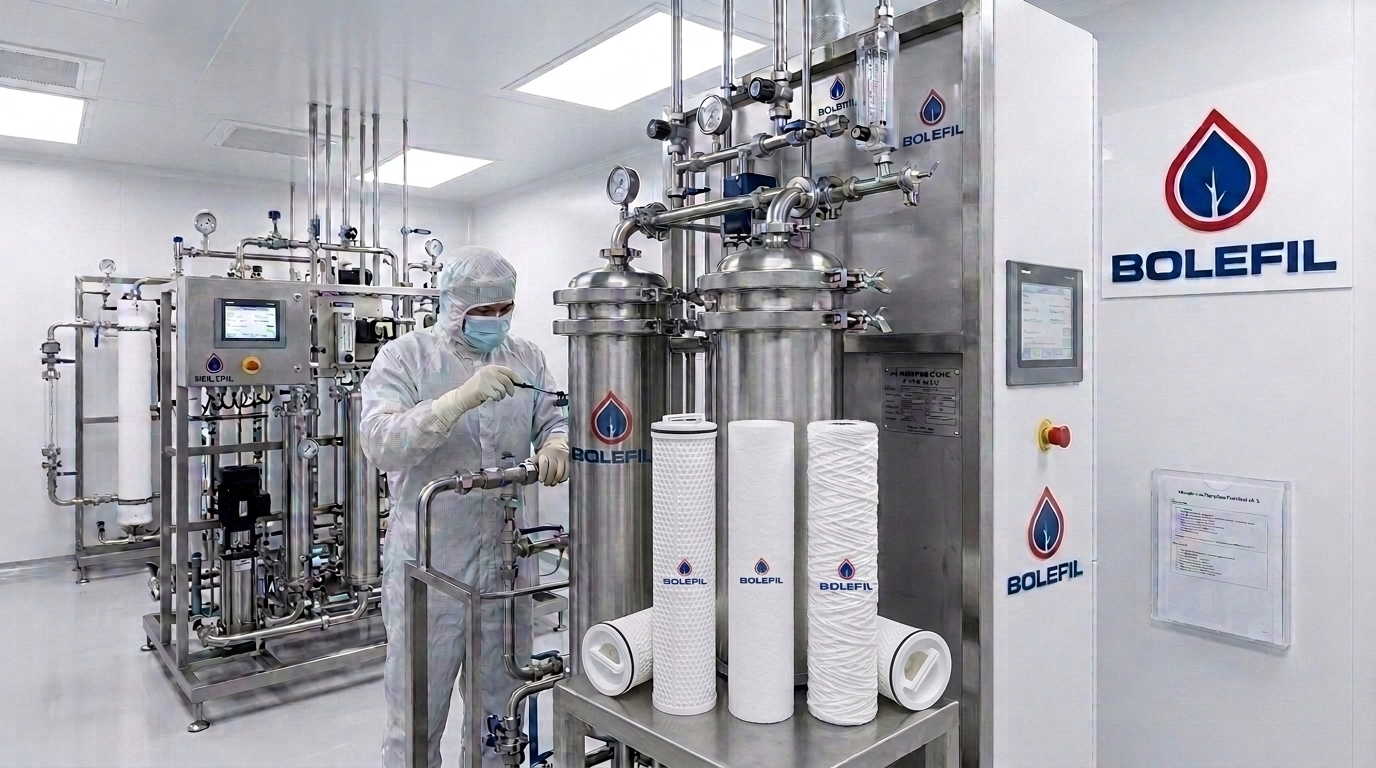 It depends on where the cartridge sits in the line and what it’s removing. For sterile filtration of aqueous pharmaceutical solutions, a 0.2 micron polyethersulfone (PES) cartridge is the standard. Upstream of that, sediment or depth filter cartridges handle particle reduction. If the feed water has chlorine or organics, an activated carbon cartridge goes in earlier still. Skip a stage, and the one after it takes the load it wasn’t sized for.
Membrane Types for Pharmaceutical Water Filtration
Membrane material drives chemical compatibility, protein binding, and how the cartridge holds up through sterilization and integrity testing. The materials aren’t interchangeable just because they’re rated to the same pore size.
PES (Polyethersulfone) vs Nylon:
PES is the default for water filtration in pharma, low protein binding, good chemical resistance, and holds up under steam sterilization. Nylon handles a wider solvent range but leaches more extractables, which rules it out for final sterile filtration. For WFI and purified water, PES has a validation history and a lower extractables profile.
PVDF Membranes:
Polyvinylidene fluoride (PVDF) has strong chemical resistance, which is why it turns up in biopharma applications involving harsh cleaning agents or elevated temperatures. It’s a common choice for the WFI distribution loop.
Mixed-bed deionization vs membrane filtration:
Mixed-bed deionization uses ion exchange resin to strip dissolved ions, producing high-purity water for lab and pharmaceutical use. Membrane filtration removes particles, microbes, and larger molecules, a physical barrier, not an ionic one. Most pharmaceutical water systems run both: deionization for ionic purity, membrane cartridges for biological and particulate control.
Activated carbon cartridges:
These don’t filter particles. They adsorb chlorine, chloramines, and dissolved organics from incoming municipal or tap water, sitting upstream to protect downstream membranes from chemical attack.
Sediment filter cartridges:
Sediment filter cartridges are simple depth filters that catch visible particulate, rust, and debris. First stage in nearly every multi-stage pharmaceutical water system, and the cheapest insurance against fouling the expensive membranes downstream.
Hydrophilic vs Hydrophobic Filter Cartridges Which Do You Need?
Hydrophilic membranes wet out immediately; no priming step is needed before water passes through. That makes them the right choice for purified water, WFI, buffer solutions, and other aqueous pharmaceutical liquids.
Hydrophobic membranes repel water and are built for gas filtration, tank vents, and steam sterilization of air lines. PTFE is the standard material here. Put a hydrophobic cartridge where a hydrophilic one belongs, and you’ll get poor flow at best, a failed integrity test at worst.
| Application | Recommended Membrane Type |
| Purified water final filtration | Hydrophilic PES, 0.2µm |
| Water for injection (WFI) | Hydrophilic PES or PVDF, 0.2µm |
| Buffer and media preparation | Hydrophilic PES or Nylon, 0.2µm |
| Tank vent/air filtration | Hydrophobic PTFE, 0.2µm |
| Steam sterilization vent | Hydrophobic PTFE |
| Prefiltration/particle removal | Depth filter, sediment cartridge |
What Is the Standard Pore Size for Sterile Grade Water Filters?
0.2 micron, validated to a 10⁻⁷ log reduction of Brevundimonas diminuta, the FDA and USP benchmark for sterilizing-grade filtration. A 0.45 micron filter ahead of it reduces bioburden, while sediment and carbon stages strip out particulate and chemical load even earlier. Layering it this way keeps the final 0.2 micron cartridge from loading prematurely.
Pore size also drives system behavior beyond contaminant removal: smaller pores mean higher pressure drop, slower flow, and faster fouling. Housing sizing, flow rate planning, and differential pressure monitoring all need to account for this, not just the pore rating on the spec sheet.
Reverse Osmosis Membrane vs Cartridge Filtration Role in Pharma Water Systems
RO and cartridge filtration solve different problems. RO membranes run under high pressure and reject dissolved salts, heavy metals, organics, and most microorganisms, typically 99%+ removal of total dissolved solids.
Cartridge filters downstream of the RO unit act as the polishing and sterile barrier stage, catching whatever microbes, fine particles, or endotoxins slip past the RO membrane. Together, RO plus downstream cartridge filtration forms the backbone of most pharmaceutical purified water and WFI pretreatment systems.
How to Choose the Right Pharmaceutical Water Filter Membrane
Pore size is only the starting point. A cartridge can be correctly rated and still cause problems if it’s incompatible with your cleaning chemicals, can’t survive your sterilization cycle, or doesn’t come with documentation your quality team can actually use.
Key Selection Criteria for Pharmaceutical Filter Cartridges
- Chemical compatibility: Will the membrane hold up against your formulation, cleaning agents (NaOH, IPA), and sanitization chemicals? Incompatible materials degrade and shed extractables into the water.
- Temperature and pressure ratings: Hot water sanitization, steam sterilization, system pressure spikes: every cartridge has a maximum differential pressure rating, and exceeding it risks membrane rupture.
- Extractables and leachables compliance: Drug contact materials need to meet USP Class VI and European Pharmacopoeia standards. Ask for extractables data tested under your actual application conditions, not generic conditions.
- Validation documentation: A Validation Guide, Certificate of Conformance, and integrity test acceptance criteria should come standard. Without them, your validation team is generating baseline data from zero.
- Sterilization compatibility: If you’re running SIP or autoclave cycles, confirm the cartridge is rated for those specific conditions and cycle counts.
Cartridge Filters for Water System Design in Pharma
Single-Use vs Multi-Use
Single-use cartridges get discarded after each campaign or set interval, no cleaning validation burden, but higher recurring consumable cost. Multi-use cartridges can be cleaned and re-sterilized within validated cycle limits, lowering long-term cost at the expense of added process complexity.
Simplex vs Duplex Housing
A simplex housing holds one cartridge and forces a system shutdown for replacement. Duplex housings run two parallel vessels, so one side can be serviced while the other stays in production. For high-volume manufacturing, duplex configurations cut downtime substantially.
Industrial Sizing
Large pharma facilities run multi-cartridge housings with 3, 7, or more cartridges per assembly. Sizing comes down to required flow rate divided by flow capacity per cartridge, with a safety margin built in for the pressure drop that accumulates as the filter loads over its service life.
Stainless steel housings are the standard. 316L resists corrosion, tolerates SIP conditions, and can be cleaned and passivated to cGMP surface finish requirements. Electropolished interiors reduce microbial attachment sites.
Pharmaceutical Filter Cartridge Specifications Checklist
- Membrane material confirmed compatible with your water type and cleaning agents
- 0.2µm pore size confirmed for sterile filtration applications
- USP Class VI and pharmacopeia-compliant materials of construction
- Third-party validation documentation and Certificate of Conformance available
- Cartridge integrity testable by bubble point and/or diffusion methods
- The extractables profile is reviewed and acceptable for your drug contact application
- Autoclave or SIP rated within your sterilization parameters
- Housing material and configuration matched to flow rate requirements
Manual Bubble Point vs Automated Diffusion Testing Pros and Cons
| Feature | Bubble Point Test | Automated Diffusion Test |
| Test principle | Pressure at which gas bubbles through a wetted membrane | Gas diffusion rate through wetted membrane at set pressure |
| Accuracy | Moderate | High |
| Operator dependency | High | Low |
| GMP suitability | Acceptable (smaller systems) | Preferred for aseptic manufacturing |
| Result documentation | Manual log entry | Automated electronic record |
| Equipment cost | Low | Higher upfront investment |
| Best used for | Development, small-scale labs | Commercial sterile manufacturing |
When to Perform Filter Integrity Testing in Pharma Manufacturing
Two checkpoints are non-negotiable:
Pre-use testing confirms the cartridge arrived undamaged and was installed correctly after wetting the membrane, before any product or water flows through for production.
Post-use testing confirms the filter stayed intact through the entire run. A failed post-use test puts everything that passed through that filter in question; batch quarantine and investigation follow. Post-use testing carries more weight for batch release than pre-use does.
Beyond these two mandatory points, testing frequency depends on validation data, batch size, and system design. Long runs may need daily testing; single-batch operations typically test once before and once after.
How to Sterilize Pharmaceutical Water Filter Cartridges Safely
Sterilization clears the microbial bioburden that builds up before a cartridge goes into service. Get the parameters wrong, and you either damage the membrane or fail to hit true sterility; neither is an acceptable outcome.
Autoclave vs Steam-in-Place (SIP) for Water Filter Cartridges
Both use saturated steam, but delivery differs. Autoclaving pulls the filter assembly out of the system and exposes it to 121°C steam for a validated hold time, typically 15 to 30 minutes at 15 psi. It suits smaller assemblies and facilities without SIP-integrated plumbing.
SIP sterilizes the cartridge in place, with steam directed through the housing at 121–135°C, depending on validation. It’s preferred at scale because the system stays closed, no transfer step, no contamination risk between sterilization and use.
Not every material tolerates the same conditions. PES and PVDF generally handle both autoclave and SIP well, but confirm the membrane, housing seals, and O-rings are all rated for your chosen method before committing.
Sintered stainless steel cartridges suit SIP particularly well in high-temperature environments; all-metal construction means no concern about polymer degradation over repeated cycles.
How Often Should Pharmaceutical Water Filter Cartridges Be Replaced?
There’s no universal interval. It depends on source water quality, the cartridge’s position in the system, sterilization frequency, and what your pressure trend data is showing.
Most 0.2 micron sterile filtration cartridges get replaced every 3 to 12 months under normal operating conditions. Prefiltration sediment cartridges often need monthly changes depending on the incoming municipal water quality.
Factors that shorten cartridge life:
- High particle loads from municipal water or weak pretreatment
- Elevated microbial bioburden accelerates membrane fouling
- Sterilization cycles approaching the validated maximum count
- High flow rates accelerate physical loading on the membrane surface
- Chemical exposure during cleaning that degrades membrane integrity over time
Most purified water systems use a dual trigger, a scheduled maximum interval, and a pressure-based threshold, and replace whichever limit hits first. WFI systems run on a tighter schedule given the higher quality bar.
Who Are the Best Pharmaceutical Water Filter Manufacturers?
A small group of suppliers dominates this market, and for good reason: validated products, full documentation packages, and technical support that actually understands pharmaceutical applications. Sticking with an established brand cuts validation time and gives your quality team a stronger regulatory footing.
Millipore vs Pall vs Sartorius Filter Cartridges for Pharma Comparison
| Brand | Key Strengths | Certifications | Best For |
| MilliporeSigma | WFI and sterile filtration portfolio, deep validation support | USP, EP, FDA, cGMP | Biopharma, large-scale manufacturing, WFI systems |
| Brother Filtration(BOLEFIL ) | High-flow capacity and high dirt-holding efficiency within a compact design | FDA,CE,NSF,PED | Manufacturing industrial-grade liquid filtration systems and replacement cartridges |
| Pall Corporation | High-throughput systems, broad membrane range | USP VI, cGMP, NSF | Process water, API manufacturing, high-volume filtration |
| Sartorius | Single-use bioprocessing, scalable solutions | USP, EU GMP, ISO | Drug manufacturing, media and buffer preparation |
| 3M Purification | Strong prefiltration and depth filter portfolio | NSF, FDA food-grade | Prefiltration stages, incoming water treatment |
| Parker Hannifin | Industrial-grade housings, high-pressure applications | cGMP, ASME | Large-scale industrial water systems, process engineering |
| Culligan | Commercial water treatment, softening, and prefiltration | NSF 42, NSF 58 | Facility-level pretreatment, commercial water conditioning |
Beyond raw performance specs, the deciding factor usually comes down to documentation depth and technical support quality. A manufacturer that hands over a full Validation Guide, regulatory correspondence, and application-specific extractables data saves your validation team real time and cost.
What Documentation Is Required for Pharma Filter Validation?
Regulators expect documented proof that your filtration process consistently delivers the required water quality. A complete validation package includes:
- Certificate of Conformance (CoC): confirms the cartridge meets manufacturing specs and lot-specific integrity acceptance criteria
- Extractables and leachables data : shows what can migrate from the cartridge into the water under worst-case conditions, within acceptable limits
- Bacterial retention validation report : confirms the required log reduction value against B. diminuta
- Integrity test protocol and acceptance criteria : bubble point or diffusion parameters specific to that cartridge model and size
- Sterilization validation data : evidence the cartridge performs to spec after the maximum validated number of cycles
- Change control documentation : notification and impact assessment if the manufacturer changes materials, processes, or suppliers
For FDA 21 CFR Part 211 or EU GMP Annex 1 submissions, this documentation is the foundation of your filtration validation master plan.
Pharmaceutical Water Filtration System Design: A Complete Overview
No cartridge operates alone. It’s one stage in a multi-stage purification system engineered to consistently hit a defined water quality grade. Understanding what each stage contributes to prefiltration, deionization, RO, and final sterile filtration makes cartridge selection, placement, and replacement decisions far more straightforward.
Frequently Asked Questions About Pharmaceutical Water Filter Cartridges
Q1: What is the best pharmaceutical water filter cartridge?
PES 0.2µm cartridges are the most validated and widely used for sterile filtration. There’s no single best option across every application; it comes down to your water grade, sterilization method, and documentation needs.
Q2: What size is a pharmaceutical water filter cartridge?
Standard cartridge lengths are 10, 20, 30, and 40 inches, usually with a 2.5-inch outer diameter for single cartridges. The right size depends on your flow rate, system pressure, and housing setup, longer cartridges give you more surface area per position.
Q3: How does a cartridge filter work in a pharmaceutical water system?
A cartridge filter works by pulling water through the membrane from the outside in, trapping particles and bacteria on the surface and within the membrane matrix. Differential pressure climbs as material builds up, signaling when it’s time to swap the cartridge.
Q4: What is a stainless steel filter cartridge housing used for in pharma? A stainless steel housing holds the cartridge in place, directs water through the membrane, and provides ports for the pressure instruments used in integrity testing. 316L electropolished steel is standard for its corrosion resistance and ease of cleaning.
Q5: Can pharmaceutical water filter cartridges remove heavy metals?
Standard 0.2µm cartridges don’t remove dissolved heavy metals on their own; that’s a job for reverse osmosis, ion exchange, or activated alumina. The RO stage in a multi-stage system handles most of that removal before water ever reaches the cartridge.
Getting This Right Matters More Than It Looks
Get the membrane material wrong, skip a pore size step, or push a sterilization cycle past its limit, and it shows up later as a failed integrity test or a batch sitting in quarantine. None of these decisions is particularly hard to get right; they just need to be made with the actual system in mind, not picked off a spec sheet in isolation.
If you’re working through cartridge selection or need a hand with validation documentation, our team works through pharmaceutical water filtration setups like this every day. Reach out to BOLEFIL and we’ll help you get the system specced correctly the first time.