

As the increasing importance to the living quality, more and more people begins to pay attention to the water they drink every day. People evaluates the water quality by the odor, taste and color. If a cup of water looks clean and clear, tastes good, then it can have a good comment by people.

To meet nowadays tasting requirements, carbon filter (CTO & GAC) is applied to many water treatment process. The carbon filter is a kind of sediment filter that has a great effect on purifying water and is mainly made of activated carbon.
Are you familiar with this material? Are you curious about how it is made and how can it remove the unpleasant odor in water? Let’s read the article, and you will find an answer.
Do you really know what is Activated carbon?
Activated carbon is an extremely effective adsorbent (also known as activated charcoal, activated coal, or active carbon).
Activated carbon can be used to cleanse, dechlorinate, deodorize, and decolorize both liquid and vapor applications because of its high surface area, pore structure (micro, meso, and macro), and a high degree of surface reactivity.

Activated carbons are also cost-effective adsorbents for a variety of industries, including water purification, food-grade products, cosmetics, automotive applications, industrial gas purification, petroleum, and precious metal recovery, mostly for gold. Coconut shells, coal, or wood are the basic components of activated carbons.
What is the production procedure of activated carbon?

Activation is one of the most important steps in the production of activated carbon. And generally, it’s divided into four main processes according to the temperature change from the thermal decomposition procedure.
- Drying
Mainly evaporates the moisture contained in the raw materials by externally supplied heat. The temperature source is controlled at about 150℃. The temperature is not high, so the chemical composition of the wooden material has not changed.
- Pre-carbonization
The thermal decomposition reaction of wood materials is obvious, and the chemical composition of raw materials begins to change due to the rising temperature, which can be about 275℃. Some unstable components like hemicellulose would generate CO2, CO1, and a small amount of acetic acid.

- Carbonization
Carbonization is the key to activated carbon that carbonizes with temperature up to 400℃. Therefore it is also called the exothermic reaction stage.
The raw material undergoes rapid thermal decomposition, generating a large number of decomposition products. The generated liquids contain a large amount of acetic acid, methanol, and wood tar. For generated gas, CO2 gradually decreases while combustible gases such as methane and ethylene gradually increase.
- Calcination
During the calcination process, the temperature reached 500℃. At this point, there were few liquid products, and the volatile substances remaining in the charcoal were discharged to increase the fixed carbon content of the charcoal.
How is activated carbon made into a GAC filter?
Similar to granular salt or granular sugar, granule-activated carbon is a porous adsorption medium with a very large internal surface area.
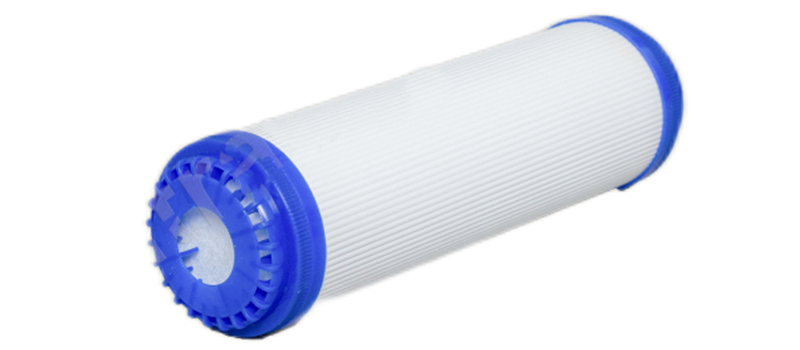
On the inside surface of the activated carbon, the adsorption takes place. Adsorption is the process of removing substances from liquids or gases by diffusing them to the surface of the adsorbent through the porous structure of activated carbon. Attractive forces then keep the substances on the surface of the adsorbent.
How is activated carbon made into a CTO filter?
Chlorine, Taste, and Odor are abbreviated as CTO. A filter that is suggested for CTO removal will result in water that is considerably clearer in color, has a better taste, and has no odors. Carbon that has been altered or “activated” to enhance surface area and create smaller pores is commonly used in CTO filters.
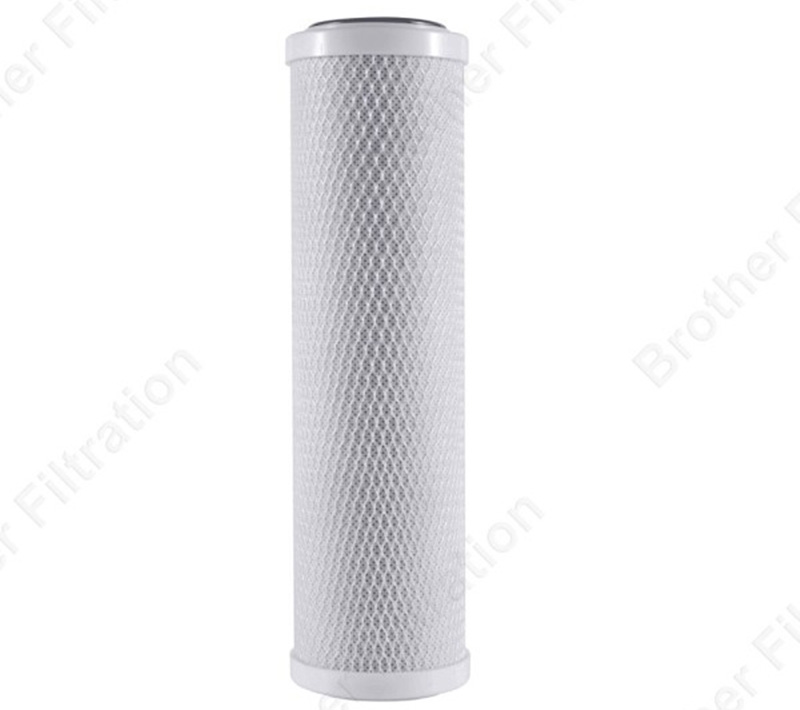
The carbon block filter compresses loose carbon blocks together to form a filter. In the carbon block filter, one pound of compressed activated carbon (the amount in a standard 10-inch filter cartridge) has a surface area equivalent to 160 acres of farm, making it one of the most absorbent materials known to man.
Difference between CTO and GAC filter
Due to the different structures inside the filter, the CTO and GAC filter cartridges have differences in filtration accuracy, dirt-holding capacity, and flow rate. If you want to know more about the detail of the difference, please read another article from us, which teaches you to choose GAC and CTO filter cartridge.
FAQ
What is an activated carbon filter used for?
Activated carbon filters remove chlorine, unpleasant taste, and odor from water, along with many organic compounds. They’re used in drinking water systems, food and beverage processing, and industrial pretreatment ahead of finer filtration stages.
What’s the difference between a CTO and a GAC filter?
A CTO (Chlorine, Taste, Odor) filter compresses carbon into a solid block, giving it tighter, more consistent filtration and a defined micron rating. A GAC (Granular Activated Carbon) filter uses loose carbon granules, which allow higher flow rates but slightly less filtration precision. [VERIFY: confirm current flow-rate and micron-rating specs for Brother’s CTO/GAC line before publishing]
Can activated carbon remove bacteria or viruses?
No. Activated carbon is effective against chlorine, odor, taste, and many organic contaminants, but it is not a microbiological barrier. Removing bacteria or viruses requires additional treatment such as UF/RO membranes or UV disinfection.
Does activated carbon remove heavy metals?
Standard activated carbon has limited effectiveness on most heavy metals. Specialty carbon media (e.g., carbon blended with ion-exchange resin) is typically needed for metals like lead. [VERIFY: confirm whether Brother offers a heavy-metal-rated carbon product to link here]
How long does an activated carbon filter last before it needs replacing?
Life depends on water quality, flow rate, and contaminant load, so replacement intervals vary by application. [VERIFY: pull Brother’s recommended replacement interval/spec sheet figures for CTO and GAC cartridges]
What is activated carbon made from?
It’s typically produced from coconut shells, coal, or wood, activated through a controlled heating process (drying, pre-carbonization, carbonization, and calcination) that creates a highly porous surface for adsorption.
Where is activated carbon filtration used industrially?
Beyond drinking water, it’s used in food and beverage processing, cosmetics manufacturing, industrial gas purification, petroleum processing, and precious metal recovery.
Which is better for my system, CTO or GAC?
It depends on your flow rate and filtration precision needs. CTO suits applications needing tighter, more consistent filtration; GAC suits higher-flow applications where slightly looser filtration is acceptable. See our full CTO vs. GAC comparison for a detailed breakdown.
Conclusion

Using activated carbon to do filtration is an effective way to remove undesired things in the water. People in this era attaches great importance to the taste and safety of drinking water.
Only clear and no odor water can be regarded as healthy and tasty water. Activated carbon filter cartridges can help a lot in water treatment, and help the water to meet the high standard.
Brother Filtration has years of filtration experience and designs and manufactures all kinds of filter products. We could be called filtration experts to some extent.
We are not only producing high-quality filter cartridges and filter housings, but also better filtration solutions for our customers. If you are interested in our carbon filter or you have any filtration problems, please feel free to contact us.
relevant products


Subscribe to our blog newsletter
Get the best, coolest and latest delivered to your inbox each week
[newsletter_form]