


String wound filter cartridges are better than other depth filters when an application needs high dirt-holding capacity, durability under pressure, and wide chemical compatibility — making them a strong choice for sediment-heavy water, industrial process fluids, and pre-RO filtration. They’re not the best choice when the goal is capturing very fine particles efficiently, since melt blown filters generally outperform string wound cartridges below a few microns..
The “better” answer depends on the application: for coarse-to-medium sediment and high dirt load, string wound wins; for high-efficiency fine filtration, melt blown or pleated filters are usually the better fit.
Key Takeaway
- String wound cartridges use depth filtration with a gradient density — tighter at the core, looser at the outer layers
- They outperform melt blown filters on dirt-holding capacity and chemical compatibility
- Melt blown filters generally outperform them on fine-particle (sub-5-micron) efficiency
- Material choice (PP, cotton, glass fiber) determines temperature and chemical resistance
- Best suited to sediment-heavy or high-dirt-load applications, not ultra-fine clarification.
What is a string wound cartridge filter?
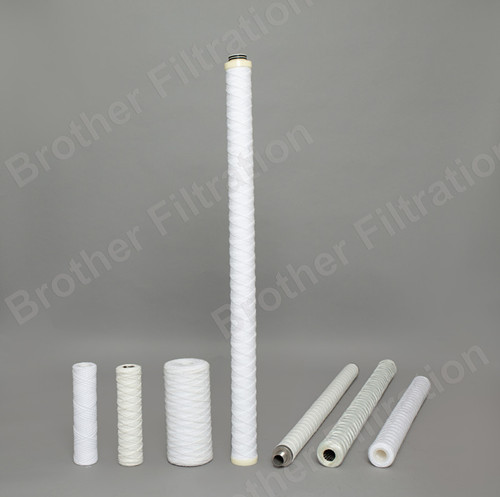
Wound Filter Cartridge is capable of eliminating rust, dirt, and other sediments from water by using fibers. The string material can be polypropylene, glass fiber, cotton, etc. It wraps on a center core like stainless steel or polypropylene.
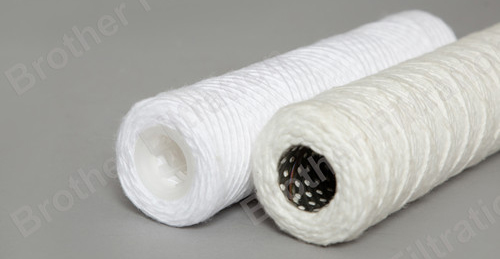
String Wound Filter Cartridges are another effective way of removing sediment particles from your water. These filters are also called depth filters because they use 2 layers of filtration to keep out unwanted particles.
The first layer catches any particles that are the same size or larger than the micron rating, while the inner layer catches smaller particles that slip through the initial filtration. This enhanced filtration comes at the cost of surface area, meaning that depth filters usually need to be cleaned/changed quicker than pleated filters.
How does a string wound filter cartridge work?
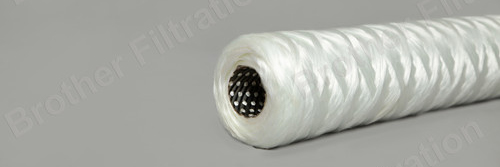
The string wound filter cartridge has a gradient density, meaning that it is tighter in the center and lighter on the edges. This implies that larger sediments are filtered out initially and that smaller particles are gradually filtered out at each layer as the liquid moves through the media. The filter’s life and effectiveness are extended by the winding pattern and controlled thickness of the cartridge, which results in a better capacity for storing dirt.
Advantages of string wound filter cartridge
Because of its filtering qualities, high dirt holding capacity, ability to maintain form, and ability to last longer, the string wound cartridge filter is widely utilized throughout industries and for many sorts of liquid filtration requirements. These kinds of filters do not break under pressure differentials if they are made well.
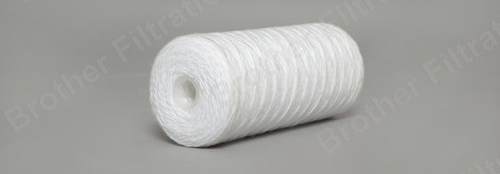
- Wide chemical compatibility and long service filter life
- A large surface area enhances the filtration efficiency of string wound filter cartridge
- String wound filter cartridges have graded pore structure for efficient removal of a wide range of particle sizes
- No odor, foaming, adhesives, and no fine fiber dropping out
For which industries it is suitable?
Due to its characteristics, string wound cartridge filters can be applied to various industries.
| Food & Beverage | Pre-RO water filtration | PCB industry |
| Drinking water filter | Chemical filter solution | Electroplate liquid filtration |
| Petrochemical process | Pharmaceuticals process | Electronics and semicondectors |
What is the difference between a string wound filter cartridge and a melt-blown filter cartridge?
There are mainly two common filter cartridges in the market, which are string wound filter cartridges and melt blown filter cartridge, many people don’t know how to select them, here we will do a comparison with them.
| Melt Blown Filter Cartridge | String Wound Filter Cartridge | ||
| Material of construction | Filter Media | Polypropylene(PP) | Polypropylene, Cotton, Glass Fiber |
| Core material | Non Core/Polypropylene/SUS304/SUS316 | Polypropylene/SUS304/SUS316 | |
| End cap type | DOE; 222fin; 222flat; 226fin; 226flat etc. |
DOE; 222fin; 222flat; 226fin; 226flat etc. |
|
| O-ring material | Silicon/ EPDM/Viton/Buna N | Silicon/ EPDM/Viton/Buna N | |
| Cartridge dimensions | OD | 64mm(2.5″ )/114mm(4.5,,) | 64mm(2.5″ )/114mm(4.5”) |
| ID | 28mm | 28mm | |
| Length | 5、10、20、30s 40、50、60、70inch | 5、10、20、30、40、50、60、70inch | |
| Removing rate | l-150um(5um a unit) | l-100um(5um a unit) | |
| Operating Conditions | PP: 80C | PP:80C, Cotton:120C, Glass Fiber:130C |
|
Who Should Use String Wound Filter Cartridges?
Water Treatment Plants
Municipal and industrial water treatment plants use string wound cartridges as pre-filtration to remove sediment, sand, and rust ahead of downstream treatment stages, protecting membranes and equipment from premature fouling.
Industrial Filtration
General industrial process lines use string wound filters wherever sediment or particulate control is needed but ultra-fine clarification isn’t the priority — coolant systems, general process water, and utility filtration are common fits.
Chemical Processing
Chemical plants favor string wound cartridges (particularly glass fiber and PP variants) for their acid, alkali, and solvent compatibility across a range of process fluids.
Food & Beverage
Cotton string wound cartridges are used in edible oil, beverage, and food processing lines, since they’re free of odor, adhesives, and foaming agents that could contaminate the product.
Pharmaceuticals
Pharmaceutical manufacturers use string wound cartridges for pre-filtration of process water and non-critical fluid streams ahead of finer membrane or pleated filtration stages.
Oil & Gas
Oil & gas operations use string wound cartridges to remove particulates and sediment from hydrocarbon fluids and injection water, where chemical compatibility and dirt-holding capacity both matter.
Municipal Water Systems
Municipal systems rely on string wound cartridges for drinking water pre-treatment, particularly in regions with high sediment loads in the source water.
Installation Tips
- Confirm the cartridge’s outer diameter and end cap type match your filter housing before installation
- Install with the tighter-wound (denser) end facing the direction of flow, per the manufacturer’s orientation guidance
- Check O-ring seating carefully — a poorly seated O-ring is one of the most common causes of bypass and reduced filtration efficiency
- Flush new cartridges briefly before bringing the system fully online to clear any loose fiber
Maintenance Best Practices
- Monitor differential pressure across the housing rather than relying on a fixed time schedule — pressure drop is the most reliable sign a cartridge needs changing
- Keep a log of change-out intervals by application to spot seasonal sediment trends in source water
- Inspect cartridges at change-out for uneven wear, which can indicate flow channeling or an oversized housing
- Store spare cartridges in a clean, dry area away from direct sunlight to prevent material degradation before use
How to choose the best string wound filter cartridge?
To ensure the filtration process is of high efficiency, we should choose the best filter cartridge. The components of a string wound cartridge filter are the core, yarn, gasket, and end cap. Adopting good quality materials, will enhance the performance of the cartridge filter.
And string wound cartridge filter will also be more durable and have a large dirt-holding capacity. When choosing the filter cartridge filter we need to take care of the following factors:
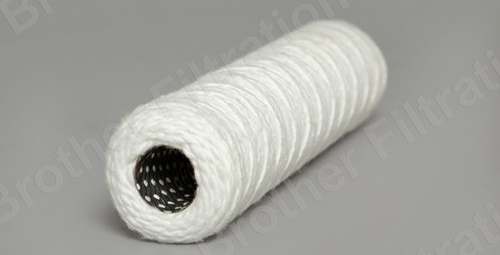
- High precision manufacturing
- A durable and sturdy core
- High-quality yarn
An excellent filter is one that uses the right materials and is expertly woven to satisfy the demands of the filtration application. A cartridge filter should have a strong core, premium-quality yarn, and highly precise production, among other desirable characteristics.
The string wound filter cartridge has better filtration capabilities and a longer lifespan thanks to the high-quality materials used in its construction.
Frequently Asked Questions
Are string wound filter cartridges better than pleated filters?
It depends on the priority. String wound cartridges offer higher dirt-holding capacity and broader chemical compatibility; pleated filters offer more surface area, lower pressure drop, and typically longer service life between change-outs.
How long do string wound filter cartridges last?
Service life depends on flow rate and sediment load rather than a fixed timeline. Most operators replace cartridges based on differential pressure reaching the housing’s rated limit rather than a calendar schedule.
What micron ratings are available?
String wound cartridges are typically available from about 1 to 100 microns, usually in 5-micron increments, to match different filtration requirements.
Can string wound filter cartridges be reused?
String wound cartridges are generally single-use and not designed to be cleaned and reinstalled, since depth filtration traps particles throughout the media rather than just on the surface.
Which industries use string wound filter cartridges?
Water treatment, food & beverage, chemical processing, pharmaceuticals, oil & gas, electronics/PCB manufacturing, and petrochemical processing all use string wound cartridges for sediment and particulate control.
How do string wound filters compare with melt blown filters?
Melt blown filters generally offer better fine-particle efficiency, while string wound filters generally offer higher dirt-holding capacity and broader chemical and temperature compatibility, depending on material.
Are string wound filter cartridges suitable for high-temperature applications?
It depends on the material. PP cartridges are rated to roughly 80°C, cotton to roughly 120°C, and glass fiber up to roughly 130°C — glass fiber is the best choice for higher-temperature process fluids.
Conclusion
String wound filter cartridges are better when an application needs high dirt-holding capacity, durability under pressure, and broad chemical compatibility think sediment-heavy water, pre-RO pre-treatment, and general industrial process fluids. They outperform pleated filters on dirt load and melt blown filters on chemical resistance and cost.
They’re not the better choice when the priority is capturing very fine particles efficiently or minimizing change-out frequency, since melt blown filters generally win on fine-particle efficiency and pleated filters offer more surface area per change out.
For most sediment and pre-filtration applications, though, a quality string wound cartridge like Brother Filtration’s ProClean range remains one of the most cost-effective, durable options available. If you have any problems or questions, please feel free to contact us.
relevant products
Subscribe to our blog newsletter
Get the best, coolest and latest delivered to your inbox each week
[newsletter_form]