...
Knowledge

Liquid filtration is a versatile and essential process used across a wide range of industries to purify liquids, remove contaminants, and ensure product quality.

From pharmaceuticals to food and beverage production, water treatment to chemical manufacturing, different types of liquid filtration systems are tailored to meet specific application needs. Understanding the various filtration methods and their unique benefits is key to selecting the right solution for your process.

In this blog, we will explore the different types of liquid filtration, their mechanisms, and how they are applied in real-world industrial scenarios to achieve optimal results.

What are Liquid Filters

What are Liquid Filters?

Liquid filters remove unwanted material from a liquid stream by passing it through a porous medium. Particles, microorganisms, and contaminants are captured; the cleaned liquid, the filtrate, moves forward at the purity level the process needs.

Industrial liquid filters are specified by micron rating, which defines the particle size the filter retains. A nominal filtration rating means the filter captures most particles above that size. An absolute filtration rating means virtually all of them. For pharmaceutical filtration, food processing, or any GMP filtration application requiring documented performance, absolute-rated media is the only defensible choice.

As the filter loads, differential pressure climbs. Managed well, through planned element changes or cleaning cycles, that is routine. Left unmanaged, it forces captured particles back through the medium and into your product.

operating principles of liquid filters

What are the operating principles of liquid filters?

Liquid filters separate solid particles, impurities, and contaminants from fluids by passing the liquid through a porous filter medium. The medium’s tiny pores allow the liquid (filtrate) to flow through while trapping larger particles, which accumulate as a filter cake. The cleaned liquid, now free of solids, is called the filtrate.

As the filter cake builds, flow resistance and pressure drop increase, influenced by factors like the cake’s porosity, compressibility, and particle surface area.

There are two main filtration types: static and dynamic. Static filtration relies on pressure differences across the medium, categorized as surface, layer, space, or depth filtration. Dynamic filtration uses membranes and cross-flow, where filtrate is absorbed perpendicular to the flow. Both methods ensure efficient separation and liquid purity.

Types of Filters for Liquid Processing

Different liquid processing applications require specific filter types to effectively remove suspended solids and maintain system efficiency. The choice of filter depends on factors such as flow rate, particle size, waste management, and operational costs.

Below are three common types of filters used in industrial liquid processing:

Cartridge Filters

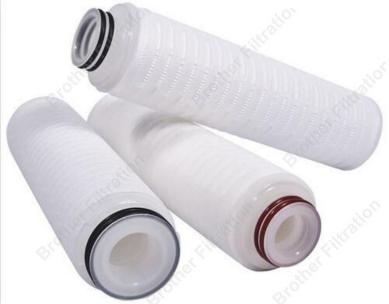
Cartridge filters are the most widely used filter type in industrial liquid filtration equipment. Replaceable elements, pleated, melt-blown, string-wound, or sintered, sit inside permanent housings ranging from polypropylene vessels for general industrial use to sanitary stainless steel filter housings built to meet the hygiene and cleanability standards of pharmaceutical and food-grade processes. 

For sterile filtration, 0.2 micron absolute-rated, FDA-compliant filtration media is the established standard. Precise particle retention and straightforward validation make them the right call in regulated environments. Where they fall short is in high-throughput, high-solids applications, where frequent element changes drive material costs and maintenance time up fast.

Cartridge Filters

Clean-In-Place (CIP) Filters

CIP filters are perfect for high-flow systems and applications where minimizing worker exposure to process liquids is critical. They efficiently capture particles as small as 1 micron and are widely used in industries requiring continuous filtration. Although the initial investment is higher, CIP filters reduce long-term operational costs by minimizing media replacements and maintenance efforts.

Bag Filters

Bag Filters

Bag filters offer significantly higher dirt-holding capacity per housing size and generate far less solid waste per cycle, a meaningful advantage when disposal adds cost or regulatory complexity. They suit batch processing, paint filtration, coolant filtration, and oil filtration well. On the cartridge filter vs bag filter question: if element changes are frequent and waste volumes are growing, bag filters usually deliver better total cost of ownership. If absolute particle retention or sterile assurance is non-negotiable, cartridges win. Most facilities end up running both cartridges for final polishing and bags for bulk upstream removal.

What are the methods of liquid filtration?

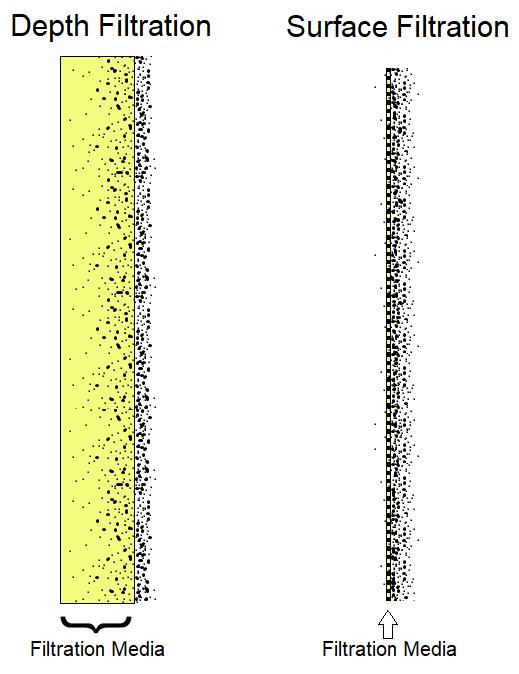
Liquid filtration is essential in many industries, including water treatment, food processing, and pharmaceuticals. The right filtration method depends on factors such as particle size, flow rate, and the specific needs of the process. Liquid filtration can be divided into two main types: surface filtration and depth filtration.

1. Surface Filtration

In surface filtration, particles are captured on the surface of the filter media, which contains small pores. Particles larger than the pore size are blocked, while smaller ones can pass through. Initially, the filtration efficiency is around 50-60%, but as the filter cake builds up, the efficiency improves and can reach close to 100%.

Advantages & Disadvantages

  • Advantages: Low initial cost, reusable after cleaning
  • Disadvantages: Less effective at retaining small particles, prone to clogging, frequent maintenance needed

2. Depth Filtration

Depth filtration captures particles throughout the entire thickness of the filter media. It uses multiple layers with varying densities, which helps trap larger particles near the surface and smaller ones deeper within the media. This structure allows depth filters to handle a larger particle load and filter finer particles more effectively.

Advantages & Disadvantages

  • Advantages: Longer lifespan, higher solid-holding capacity, effective for a range of particle sizes
  • Disadvantages: Higher initial cost, may require higher pressure for operation
surface filtration and depth filtration

Other Liquid Filtration Methods

In addition to surface and depth filtration, there are other methods tailored to specific processes:

  • Membrane Filtration: Uses semi-permeable membranes to separate particles, bacteria, and dissolved substances based on size, commonly used in water purification and medical fields.
  • Thermal Filtration: Removes impurities from crystallized compounds by filtering at high temperatures.
  • Cold Filtration: Removes oils, fats, and proteins by filtering at low temperatures, where these substances solidify.
  • Multilayer Filtration: Used in water treatment, this method employs layers of granular materials arranged by fineness to prevent clogging and improve filtration efficiency.
Other Liquid Filtration Methods

What is liquid filtration used for?

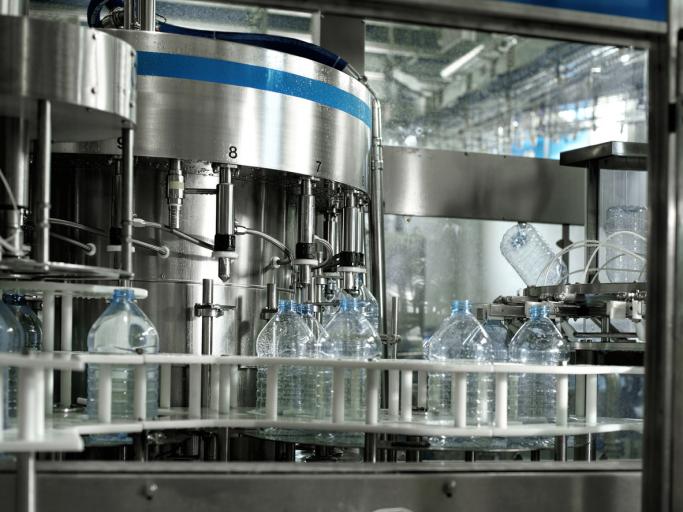
Liquid filtration removes unwanted particles, contaminants, and impurities from liquids, ensuring their cleanliness and suitability for various applications. This process is widely used across industries such as water treatment, food and beverage production, pharmaceuticals, and chemical manufacturing.

In water treatment, filtration purifies water by eliminating harmful substances, making it safe for drinking, industrial use, or environmental discharge. In the food and beverage industry, it maintains product quality by filtering out particles that could affect taste, texture, or shelf life. In pharmaceuticals and biotechnology, filtration ensures sterility and removes contaminants, which is necessary for the safety and effectiveness of medications and vaccines.

Liquid filtration supports industrial processes by ensuring the quality, safety, and efficiency of liquids in diverse applications. Advanced filtration technologies help industries meet standards, improve product performance, and protect human health and the environment.

What is liquid filtration used for

What are the considerations in selecting liquid filters?

When designing a liquid filtration system and selecting the appropriate filtration equipment, several critical factors must be considered to ensure optimal performance and efficiency.

Here are the key considerations:

  • Flow Rate: Ensure the filter can handle the required volume and withstand the liquid’s pressure and turbulence.
  • Operation Mode: Decide if the filter will operate in batch or continuous mode.
  • Liquid Properties: Assess viscosity, temperature, and whether the liquid is hazardous or requires high-pressure handling.
  • Particle Size: Choose a filter with openings smaller than the particles to be removed. Different filtration levels (microfiltration, ultrafiltration, etc.) suit varying particle sizes.
  • Filtration Efficiency: High purity is critical in applications like drinking water or food processing.
  • Cost: Evaluate total ownership costs, including maintenance and replacement. Cheaper filters may cost more long-term due to frequent replacements.

How to Choose a Liquid Filter?

A few factors that, if overlooked, almost always surface as problems later:

  • Micron rating: nominal for general industrial use; absolute-rated and validated for regulated or sterile applications
  • Flow rate: size for peak throughput, not average, and account for rising differential pressure as the element loads
  • Liquid properties: viscosity, temperature, and chemical compatibility determine media material: polypropylene for general use, PTFE for aggressive chemistries, sintered stainless steel for high-temperature or high-pressure conditions
  • Operation mode: batch processes can schedule media changes; continuous processes need CIP systems or redundant filter trains
  • Total cost of ownership: element cost, replacement frequency, disposal, and labour. The cheapest filter to buy is rarely the cheapest to run.

At Brother Filtration, we supply filter cartridges, bag filter systems, CIP filter housings, and membrane filtration solutions across water treatment, food and beverage, pharmaceutical, chemical, and energy industries. More importantly, we ask the right questions before recommending anything.

Conclusion

Filtration is essential for separating solids from liquids or gases, and with the right methods, we help you achieve efficiency and reliability. We offer a wide range of filtration products and solutions, including filter cartridges, bags, and housings, serving industries like water treatment, food and beverage, and energy.

Beyond supplying filters, we focus on understanding your challenges to design customized solutions. Partner with us to transform your filtration challenges into optimized results.

Subscribe to our blog newsletter

Get the best, coolest and latest delivered to your inbox each week

Have Questions?